
AI Weekly Roundup September 14th-20th: Four Game-Changing Developments That Signal the Industry’s Infrastructure Shift

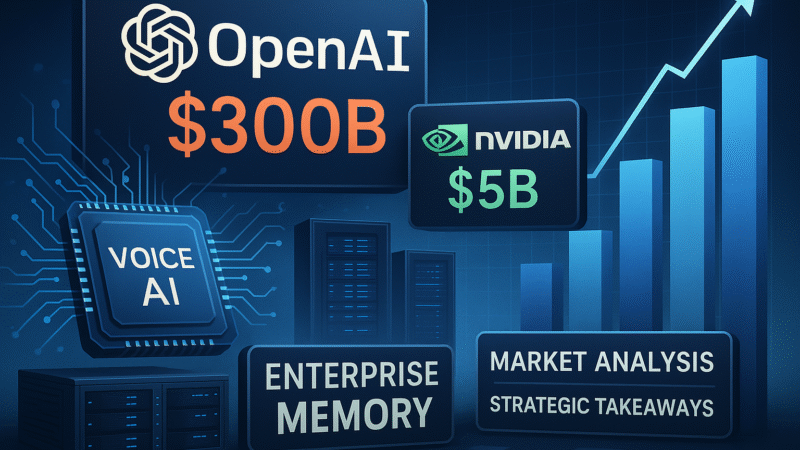
📊 Weekly Executive Summary
Four major AI developments this week signal a fundamental industry shift toward infrastructure consolidation and enterprise-grade capabilities.
Navigate This Week’s Key Developments
This week delivered unprecedented developments that fundamentally reshape how we understand AI infrastructure, partnerships, and enterprise adoption. From record-breaking cloud contracts to former rivals joining forces, these announcements signal that the AI industry is entering a new phase of consolidation and massive capital deployment.
Based on my analysis of market movements, executive statements, and technical specifications, this week marks a critical inflection point. Companies are no longer just building better models—they’re securing the physical and financial infrastructure to dominate the next decade of AI transformation.
OpenAI’s Historic $300 Billion Infrastructure Gamble
The AI industry was stunned this week when OpenAI and Oracle announced a $300 billion, five-year agreement that ranks among the largest cloud contracts ever signed. The scale is staggering: the deal requires 4.5 gigawatts of electricity, roughly equal to what 4 million U.S. homes consume.
💡 Infrastructure Reality Check: This deal represents 30x OpenAI’s current annual revenue. What’s your take on whether this signals confidence or desperation? Share your analysis – we’re seeing dramatic shifts in AI economics.
Financial Reality vs. AI Ambitions
The numbers tell a sobering story. OpenAI reported annual recurring revenue of $10 billion as of June, yet this Oracle contract commits them to $60 billion per year. Industry analysts are raising serious questions about the financial sustainability.
“OpenAI hasn’t even gotten the for-profit conversion approved and is promising people 300 billion dollars?” noted Miles Brundage, former OpenAI policy research head. The disconnect between current revenue and future commitments has sparked fresh concerns about an AI bubble.
OpenAI Revenue vs. Oracle Commitment
Strategic Infrastructure Play
Beyond the financial concerns, this deal represents OpenAI’s strategy to diversify infrastructure across multiple cloud providers, reducing dependence on Microsoft Azure. OpenAI moved away from exclusively using Microsoft Azure in January, coinciding with involvement in the Stargate Project.
For Oracle, the transformation is remarkable. Larry Ellison’s courting of NVIDIA CEO Jensen Huang allowed Oracle to secure a large stockpile of top-tier NVIDIA GPUs, positioning it as a significant AI infrastructure player. The deal sent Oracle’s stock soaring 36% in a single day, briefly making Ellison the world’s richest person.
NVIDIA Rescues Intel: The $5 Billion Strategic Partnership
In another shocking development, NVIDIA announced a $5 billion investment in Intel at $23.28 per share, alongside a collaboration to develop custom data center and PC products. This partnership between former rivals signals a dramatic reshuffling of the semiconductor landscape.
NVIDIA-Intel Partnership Details
Investment Structure: $5B at $23.28/share (7% discount to closing price)
Focus Areas: Custom x86 CPUs for AI infrastructure, integrated PC solutions
Timeline: Subject to regulatory approval, year-long discussion process
Market Impact: Intel shares surged 22.8%, best day since 1987
From Dominance to Dependence
The partnership highlights how dramatically the semiconductor landscape has shifted. Intel was once the standard-bearer for semiconductors but struggled with multiple CEO changes, technical blunders, and falling behind in mobile and AI. Intel shares are down 31.78% over five years, while NVIDIA shares are up 1,348%.
NVIDIA CEO Jensen Huang called it “an incredible investment” after year-long discussions with Intel CEO Lip-Bu Tan. The collaboration will integrate NVIDIA’s AI and accelerated computing with Intel’s x86 ecosystem using NVIDIA NVLink technology.
🤔 Partnership or Acquisition Preview? With Intel’s market cap at just $143B versus NVIDIA’s $4.25T, is this partnership setting up a future takeover? What’s your prediction – the semiconductor landscape is rapidly consolidating.
NVIDIA-Intel Partnership Evolution
Technical Integration Strategy
The partnership goes beyond financial investment. For data centers, Intel will build NVIDIA-custom x86 CPUs that NVIDIA will integrate into its AI infrastructure platforms. For personal computing, Intel will build x86 system-on-chips that integrate NVIDIA RTX GPU chiplets.
Notably, the deal focuses on Intel’s product division, not its struggling foundry business, though future foundry partnerships weren’t ruled out. This suggests NVIDIA wants Intel’s design capabilities and x86 licensing, not necessarily its manufacturing capacity.
Microsoft’s Voice AI Breakthrough with MAI-Voice-1
Microsoft quietly launched a significant voice AI advancement this week with MAI-Voice-1, their first highly expressive speech generation model that can produce a full minute of audio in under one second on a single GPU. The technology debuts in Copilot Audio Expressions within Microsoft’s experimental Copilot Labs platform.
MAI-Voice-1 Capabilities
Speed: 1 minute of audio generated in <1 second
Modes: Scripted (verbatim), Emotive (dramatic), Story (multi-character)
Quality: High-fidelity, emotionally rich across single/multi-speaker scenarios
Practical Applications
Content Creation: Instant podcast/audiobook generation
Education: Interactive storytelling and guided meditations
Business: Meeting summaries and presentation narration
Technical Innovation Behind the Speed
The breakthrough lies in efficiency. MAI-Voice-1 delivers extraordinary efficiency, capable of generating a full minute of audio in under one second on a single GPU, making it one of the most efficient speech systems available. This represents a significant advancement over traditional text-to-speech systems that often require multiple GPU minutes for similar output.
Microsoft AI Manager Mustafa Suleyman announced three distinct modes: Scripted mode reads input verbatim, Emotive mode adds dramatic flair, and Story mode performs multiple voices and characters. The system integrates with Microsoft’s broader Copilot ecosystem, positioning voice as the interface of the future for AI companions.
Strategic Positioning Against Competitors
Microsoft’s voice AI strategy directly challenges Google’s Gemini voice capabilities and OpenAI’s voice features. Early testing shows the system produces human-like audio output that users find more personal than ChatGPT’s voice interactions.
The timing is strategic, as voice interfaces become increasingly important for AI adoption. Voice is envisioned as the interface of the future for AI companions, and MAI-Voice-1 delivers this vision through lightning-fast performance and realism.
Anthropic’s Enterprise Memory Push
Anthropic joined the memory feature race this week by introducing memory to Claude for Team and Enterprise plan users, enabling the AI to remember projects and preferences across conversations. While arriving later than competitors, Anthropic’s implementation prioritizes enterprise-grade controls and project-specific boundaries.
— Anthropic Product Team
Enterprise-First Memory Design
Claude’s implementation uses project-scoped memory with strict isolation and requires explicit activation, prioritizing privacy and preventing context leakage between clients or projects. This design philosophy aligns with Anthropic’s safety-first mindset and enterprise compliance needs.
The feature includes practical enterprise controls: Enterprise admins can choose whether to disable memory for their organization at any time, and users can download Claude’s memories for specific projects and move them to third-party chatbots.
| Feature | Claude Memory | ChatGPT Memory | Gemini Memory |
|---|---|---|---|
| Launch Date | September 2025 | February 2024 | February 2025 |
| User Control | Granular project-scoped | Basic on/off toggle | Limited control |
| Privacy Isolation | Project boundaries | Global memory pool | Basic separation |
| Enterprise Admin Controls | Full disable capability | Limited admin options | No enterprise controls |
| Export/Import | Cross-platform export | No export option | No export option |
| Availability | Team/Enterprise only | All paid users | All users |
Claude Memory
ChatGPT Memory
Gemini Memory
Incognito Mode and Privacy Innovation
Alongside memory, Anthropic introduced Incognito chats that don’t appear in conversation history or save to memory, perfect for sensitive brainstorming or confidential strategy discussions. This addresses enterprise concerns about data retention and compliance.
🔒 Enterprise Memory Concerns: With memory features becoming standard, how important are project-scoped controls for your organization? Share your privacy requirements – enterprise AI adoption depends on robust data controls.
Market Impact Analysis & Future Implications
These four developments collectively represent a fundamental shift in AI industry dynamics. The common thread: massive capital deployment, infrastructure consolidation, and enterprise-focused capability development.
Infrastructure Investment Acceleration
The scale of infrastructure investment is unprecedented. Morgan Stanley estimates global outlays on chips, servers, and data centers will climb to nearly $3 trillion by 2028. OpenAI’s Oracle deal exemplifies this trend, but it’s not alone: Meta CEO Mark Zuckerberg announced plans to spend “hundreds of billions” on gigawatt-scale data centers, while Google is investing $9 billion in Oklahoma data center expansion.
AI Infrastructure Investment Acceleration (2025-2028)
Physical infrastructure development accelerating rapidly, with major builds in Wyoming, Texas, Michigan, Pennsylvania, and New Mexico.
NVIDIA GPU requirements driving unprecedented chip demand, with Oracle planning tens of billions in semiconductor purchases.
Energy infrastructure development becoming critical bottleneck, with 4.5GW requirements equivalent to multiple nuclear reactors.
Memory, voice, and productivity features rapidly becoming standard enterprise requirements rather than experimental additions.
Competitive Landscape Reshuffling
Traditional industry hierarchies are crumbling. Intel, once the semiconductor king, now depends on its former rival NVIDIA for relevance. Oracle, considered a legacy database company, suddenly emerges as a critical AI infrastructure provider. These partnerships signal that AI productivity gains are reshaping entire industries.
The convergence is clear: companies are no longer just building better models—they’re securing the physical and financial infrastructure to dominate the next decade. This week’s announcements represent strategic positioning for an AI landscape where infrastructure access determines competitive advantage.
Strategic Takeaways for Business Leaders
Infrastructure Dependencies Are Strategic Assets
OpenAI’s willingness to commit $300 billion for infrastructure access demonstrates that compute capacity is becoming more valuable than model improvements. For businesses, this suggests:
- Multi-cloud strategies are essential – Avoid single-vendor dependencies that could limit scaling options
- Infrastructure partnerships matter – Consider relationships with cloud providers as strategic alliances, not commodity purchases
- Energy planning is critical – AI deployment requires serious power planning and energy cost analysis
Enterprise Features Drive Adoption
Anthropic’s focus on enterprise-grade memory controls and Microsoft’s integration of voice AI into business workflows highlight that agentic AI systems succeed through practical business applications, not just impressive demos.
Key requirements emerging:
- Data governance and privacy controls – Project-scoped memory and incognito modes are becoming standard
- Administrative oversight capabilities – Enterprise buyers demand full control over AI behavior and data usage
- Cross-platform interoperability – The ability to export and migrate AI memories prevents vendor lock-in
Voice Interfaces Reach Production Quality
Microsoft’s MAI-Voice-1 breakthrough signals that voice AI has reached enterprise production quality. The 60x speed improvement over traditional systems makes real-time voice interaction practical for business applications.
Implementation considerations:
- Customer service transformation – Real-time voice AI can handle complex customer interactions with human-like quality
- Content creation acceleration – Instant audio generation changes content production economics
- Accessibility improvements – High-quality voice interfaces expand AI access for users with different needs
Frequently Asked Questions
What does OpenAI’s $300 billion Oracle deal mean for the AI industry?
The deal represents a fundamental shift toward massive AI infrastructure investments, with OpenAI securing 4.5 gigawatts of computing power starting in 2027. This signals that AI companies are moving beyond model development to securing the physical infrastructure needed for AI at scale. The financial commitment—30x OpenAI’s current revenue—indicates either extraordinary confidence in AI growth or concerning overcommitment to infrastructure that may not generate sufficient returns.
Why did NVIDIA invest $5 billion in struggling Intel?
NVIDIA’s investment creates a strategic partnership combining Intel’s x86 CPU technology with NVIDIA’s AI acceleration capabilities. This allows both companies to develop integrated data center and PC products while diversifying NVIDIA’s ecosystem beyond pure GPU sales. For Intel, it provides crucial capital and market relevance in the AI era. The partnership also positions both companies against AMD’s growing influence in AI-optimized processors.
How does Microsoft’s MAI-Voice-1 compare to other voice AI models?
MAI-Voice-1 can generate a full minute of high-quality, expressive audio in under one second on a single GPU, making it one of the most efficient voice generation systems available. This 60x speed improvement over traditional text-to-speech systems enables real-time voice interactions for business applications. The system supports multiple voice styles and can handle both single-speaker and multi-character scenarios, positioning Microsoft competitively against OpenAI’s voice features and Google’s Gemini voice capabilities.
What makes Anthropic’s memory feature different from ChatGPT’s memory?
Anthropic’s memory implementation prioritizes enterprise-grade controls with project-scoped isolation, preventing context leakage between different clients or projects. Unlike ChatGPT’s global memory pool, Claude’s memory can be exported to other AI systems and includes granular user controls. Enterprise administrators can disable the feature entirely, and the system includes incognito mode for sensitive conversations that don’t save to memory.
Are we seeing an AI infrastructure bubble?
The unprecedented scale of infrastructure commitments—with OpenAI promising $300 billion despite $10 billion in current revenue—raises legitimate bubble concerns. However, these investments reflect the massive computational requirements for advanced AI systems and the strategic importance of securing infrastructure access. Whether demand will justify these commitments depends on AI adoption rates and the economic value generated by AI applications over the next decade.
Looking Ahead: The Infrastructure-First AI Era
This week’s developments mark the beginning of an infrastructure-first era in AI. Success will increasingly depend on securing computing capacity, power access, and enterprise-grade capabilities rather than just model improvements.
The companies making massive infrastructure bets today—OpenAI with Oracle, NVIDIA with Intel, Microsoft with voice AI, and Anthropic with enterprise features—are positioning for an AI landscape where physical and financial scale determines competitive advantage.
For business leaders, the message is clear: AI strategy must include infrastructure planning, vendor relationship management, and enterprise integration capabilities. The window for building these foundations is narrowing as demand outpaces supply across the entire AI infrastructure stack.
Stay Ahead of AI Infrastructure Developments
The AI landscape is evolving faster than ever. Our weekly analysis helps business leaders understand how these infrastructure shifts impact strategy, investment, and competitive positioning.
What’s your biggest AI infrastructure challenge for 2025? Share your insights and questions in the comments below.
Sources & Further Reading
- TechCrunch: Oracle-OpenAI Deal Analysis
- PYMNTS: $300 Billion Cloud Agreement Details
- NVIDIA Official: Intel Partnership Announcement
- CNBC: Jensen Huang on Intel Investment
- PCWorld: Microsoft Copilot Audio Expressions
- Anthropic Official: Claude Memory Feature Launch
- SiliconAngle: Claude Memory Analysis
- Fortune: AI Bubble Concerns
- Computerworld: Enterprise Memory Implementation
- WinBuzzer: Stargate Project Revival
💬 What’s your take on this week’s biggest AI developments? Are we witnessing smart infrastructure planning or an unsustainable AI bubble? Join the discussion and share your perspective on how these changes will impact your industry.