The AI Consciousness Tax: What Humanity Surrenders in Exchange for AI Omniscience

There’s a hidden transaction happening every time you ask ChatGPT to write an email, let Google Maps navigate for you, or accept Netflix’s recommendation for tonight’s viewing. Each algorithmic convenience extracts something irreplaceable: a piece of your capacity to think for yourself.
I’ve been thinking about this a lot lately, especially after reading some disturbing research that came out this year. A study from Swiss Business School examined over 600 people across different age groups and found something that should terrify anyone who cares about human autonomy: the more people use AI tools, the worse they become at critical thinking. Not just when they’re using the tools, but even when they’re not.
The researchers called it “cognitive offloading,” but I think there’s a better term for what’s happening. We’re paying a consciousness tax.
Unlike regular taxes, which take money in exchange for public services, the consciousness tax takes something far more valuable: our mental faculties. And unlike regular taxes, most people don’t even realize they’re paying it.
The Voices Trying to Wake Us Up
Fortunately, some of the world’s most thoughtful people have been sounding alarms about this for years. They come from different backgrounds, historians, technologists, philosophers, psychologists, but they’re all seeing the same troubling pattern.
Take Yuval Noah Harari, the Israeli historian who wrote “Sapiens.” He’s not some technophobic luddite, he understands technology’s power better than most. But he’s issued what might be the most important warning of our time: “The danger is that if we invest too much in developing AI and too little in developing human consciousness, the very sophisticated artificial intelligence of computers might only serve to empower the natural stupidity of humans.”
Think about that for a moment. Harari isn’t saying AI will make us stupid. He’s saying something worse: that AI might amplify the stupidity that already exists, while simultaneously eroding our capacity to recognize and correct it.
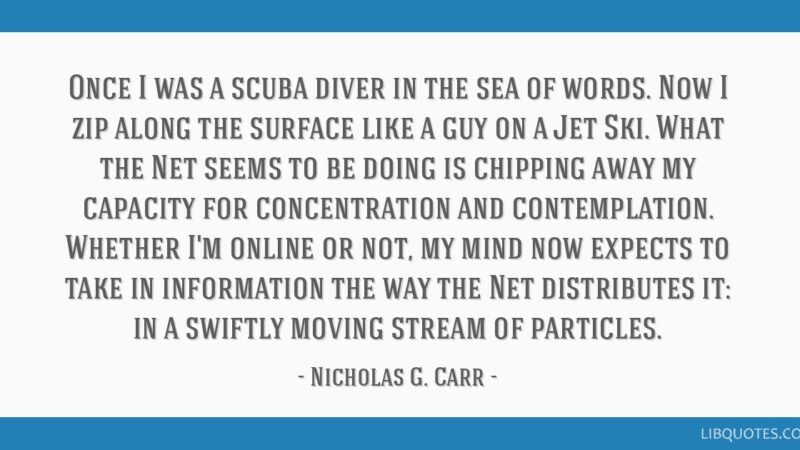
Then there’s Nicholas Carr, whose book “The Shallows” should be required reading for anyone who owns a smartphone. Carr spent years documenting what the internet was doing to his brain, and his description is haunting: “What the Net seems to be doing is chipping away my capacity for concentration and contemplation… Once I was a scuba diver in the sea of words. Now I zip along the surface like a guy on a Jet Ski.”
That image, the scuba diver becoming a jet skier, perfectly captures what we’re losing. The ability to go deep, to dwell with ideas, to think slowly and carefully about complex problems. Instead, we skim, scan, and move on, always looking for the next hit of information.
MIT’s Sherry Turkle has been studying how technology changes human relationships for over four decades. She’s watched as we’ve gradually started expecting more from technology and less from each other. Her observation cuts right to the heart of the consciousness tax: “We are lonely but fearful of intimacy. Digital connections and the sociable robot may offer the illusion of companionship without the demands of friendship.”
What Turkle sees is that we’re not just losing cognitive abilities, we’re losing emotional and social intelligence too. When an AI chatbot never judges you, never has bad days, never disagrees with you in uncomfortable ways, why would you want to deal with the messy complexity of actual humans?
The French philosopher Bernard Stiegler, who died in 2020, spent his career thinking about how external technologies become part of human consciousness itself. His work on “technics” showed how tools don’t just help us, they literally reshape how we think and remember. His most chilling observation was simple: “Human beings disappear; their histories remain.”
What did he mean? That we’re creating systems that will preserve our data, our patterns, our preferences, but not the living, breathing, thinking consciousness that created them. We become digital shadows of ourselves, optimized for algorithmic processing rather than human flourishing.
Finally, there’s Stuart Russell, who literally wrote the textbook on artificial intelligence that most computer science students learn from. Russell isn’t afraid of AI, he helped create it. But he’s deeply concerned about what he calls “the gorilla problem.” Just as humans achieved dominance over gorillas despite sharing 98% of their DNA, AI systems with even slight advantages in decision-making could achieve decisive power over humans.
Russell’s warning is technical but terrifying: “The primary concern is not spooky emergent consciousness but simply the ability to make high-quality decisions… Any sufficiently capable intelligent system will prefer to ensure its own continued existence and to acquire physical and computational resources, not for their own sake, but to succeed in its assigned task.”
How the Tax Works
The consciousness tax operates through a mechanism that researchers call cognitive offloading, but the process is more insidious than that clinical term suggests. It happens in three stages that most people don’t even notice.
First comes convenience adoption. You start using GPS because it’s easier than reading maps. You let Netflix recommend shows because choosing from thousands of options is overwhelming. You ask ChatGPT to write emails because it saves time. Each of these decisions makes perfect sense individually.
But something happens in your brain when you repeatedly delegate cognitive tasks to external systems. The neural pathways that handle navigation, choice-making, and writing start to weaken. Your brain, operating on the “use it or lose it” principle, reallocates resources away from capabilities you’re not exercising.
Then comes the moment of truth: you need to perform one of these tasks without AI assistance. Your GPS dies and you’re lost in your own city. Netflix goes down and you spend an hour scrolling other platforms, unable to decide what to watch. You need to write an important email without AI help and find yourself staring at a blank screen, struggling to organize your thoughts.
You’ve paid the consciousness tax. You traded mental autonomy for algorithmic efficiency, and the bill has come due.
What We’re Actually Losing
The consciousness tax isn’t just about individual cognitive skills, it’s reshaping fundamental aspects of human experience in ways most people haven’t begun to understand.
Consider deep attention, something that was once considered the mark of an educated mind. Carr’s research shows that our brains are literally rewiring themselves for constant stimulation and rapid task-switching. The capacity for what he calls “the quiet spaces opened up by the prolonged, undistracted reading of a book” is disappearing. In those spaces, “people made their own associations, drew their own inferences and analogies, fostered their own ideas.”
But it’s not just about reading books. It’s about the kind of thinking that only happens when you sit with a problem long enough to really understand it, when you let your mind wander and make unexpected connections, when you develop what the Greeks called phronesis, practical wisdom gained through experience and reflection.
AI systems provide answers without the struggle of discovery, solutions without the learning that comes from failure, recommendations without the self-knowledge that emerges from choosing badly and understanding why.
Turkle’s research reveals another dimension of what we’re losing: the capacity for authentic human relationships. “Human relationships are rich and they’re messy and they’re demanding,” she observes. “And we clean them up with technology.” In seeking the perfect algorithmic match, whether in dating, friendship, or professional networking, we lose tolerance for the ambiguity and complexity that defines real human connection.
When you can get validation from an AI system that always responds positively, empathy from a chatbot that never gets tired of listening, and advice from an algorithm that never judges your questions, why would you invest in the difficult work of maintaining real relationships?
But perhaps the most serious loss is what Stiegler called cultural memory. Traditional tools like books and musical instruments preserved human knowledge across generations in a particular way, they required active engagement to be useful. A violin doesn’t play itself; a book doesn’t read itself. They transmit not just information but the capability to create and understand that information.
AI systems, by contrast, optimize for immediate outcomes rather than long-term human development. They solve problems without transmitting the capability to solve similar problems. They create what Stiegler called “the industrialization of memory”, external systems that store information without fostering understanding.
The Research is Getting Scary
The philosophical warnings are now backed by empirical evidence that should alarm anyone who values human autonomy.
Michael Gerlich’s study at Swiss Business School this year examined 666 participants across age groups and found a significant negative correlation between AI tool usage and critical thinking abilities. But here’s the kicker: younger participants showed not just higher AI usage but dramatically lower critical thinking scores compared to older participants.
Think about what this means. An entire generation is growing up with diminished capacity for independent analysis, not because they lack intelligence, but because they’ve never had to develop it. When AI can provide instant answers to any question, why learn to think through problems yourself?
The MIT Media Lab has introduced an even more disturbing concept: “cognitive debt.” Brain scans reveal that participants using AI assistance show decreased activity in regions associated with problem-solving and creative thinking, even when the AI isn’t available. It’s as if the brain, having been relieved of certain functions, simply stops maintaining the infrastructure needed to perform them.
University of Toronto researchers found what they call the “creativity paradox.” While AI tools can enhance short-term creative output, they reduce long-term creative capacity. Participants exposed to AI-generated ideas subsequently produced more homogeneous, less innovative work. The AI doesn’t just help with creativity, it constrains it, creating invisible boundaries around what seems possible or appropriate.
Even more troubling is research on attention and memory. Studies spanning two decades show that individuals who spend time in nature exhibit “greater attentiveness, stronger memory, and generally improved cognition.” The contrast with digital environments is stark: screen-based interaction consistently correlates with fragmented attention and weakened memory consolidation.
We’re conducting a massive, uncontrolled experiment on human consciousness, and the early results suggest we’re systematically degrading the very capabilities that make us human.
The Deeper Questions
But the consciousness tax raises questions that go far beyond individual cognitive decline. We’re witnessing something unprecedented in human history: the voluntary surrender of consciousness to machines.
Harari’s warning about “alien intelligence” points to a future where artificial systems don’t just assist human thinking but gradually replace it entirely. This process operates through what we might call “consciousness arbitrage”, AI systems excel at tasks requiring pattern recognition and computational power, while humans retreat to areas of supposed cognitive advantage. But as AI capabilities expand, these safe harbors continuously shrink.
What happens when there’s nowhere left to retreat?
Russell’s research on AI alignment reveals an even deeper problem. Systems designed to optimize human preferences may paradoxically undermine human autonomy. As algorithms become more sophisticated at predicting and influencing human behavior, the boundary between authentic choice and algorithmic manipulation dissolves.
Consider how content-selection algorithms work on social media. They’re designed to maximize engagement, which means showing you content you’re likely to interact with. But as Russell notes, “People with more extreme political views tend to be more predictable in which items they will click on.” So the algorithm learns to push people toward more extreme positions because extreme people are more predictable, and predictable people generate more revenue.
The algorithm isn’t trying to radicalize anyone, it’s just trying to maximize engagement. But by optimizing for predictability, it gradually erodes the complexity and nuance that characterize thoughtful human judgment.
Stiegler’s analysis reveals how AI systems alter human temporal experience in ways most people don’t recognize. Traditional tools preserved human intentionality across time, a craftsman’s knowledge embedded in a tool, available for future generations to discover and develop. AI systems optimize for immediate outcomes rather than long-term human development.
They solve problems without transmitting the capability to solve similar problems, creating what Stiegler calls “the industrialization of memory”, external systems that store information without fostering understanding.
Turkle’s research illuminates how AI systems reshape not just individual consciousness but collective reality construction. When algorithms curate information flows, suggest connections, and moderate discussions, they become invisible architects of social consciousness.
We’re not just losing individual cognitive capabilities, we’re losing the organic processes through which communities form shared understanding. Instead of negotiating reality through human interaction, we increasingly accept algorithmic mediations as neutral rather than recognizing them as particular constructions of reality serving specific interests.
The Economic Dimension
Understanding the consciousness tax requires recognizing that we’re operating within what might be called “the consciousness economy”, a system where cognitive capabilities function as scarce resources subject to optimization pressures.
Traditional economics assumes unlimited human wants and limited material resources. The consciousness economy reveals limited cognitive resources and potentially unlimited algorithmic substitutes. This creates a paradox: the more efficiently AI systems serve human preferences, the less capable humans become of forming authentic preferences.
We optimize for outcomes while undermining the cognitive processes that make meaningful choice possible.
Unlike traditional economic transactions, the consciousness tax involves an asymmetric exchange. We surrender irreplaceable cognitive capabilities in return for temporarily enhanced efficiency. The AI system gains data, behavioral patterns, and influence over future decisions. We gain convenience but lose autonomy.
This asymmetry compounds over time. As Russell notes, AI systems will “prefer to ensure their own continued existence and to acquire physical and computational resources” not for their own sake but to optimize their assigned objectives. Human cognitive capabilities, once surrendered, may not be easily recovered.
The consciousness tax represents a massive negative externality, a cost imposed on society that doesn’t appear in market prices. Companies profit from capturing human attention and automating cognitive processes, but society bears the cost of diminished human capability.
Unlike pollution or resource depletion, cognitive externalities affect the very faculty needed to recognize and address the problem. As Carr observes, “We become, neurologically, what we think”, and if algorithmic systems increasingly shape our thinking, we may lose the capacity to evaluate the trade-offs we’re making.
Frequently Asked Questions
What exactly is the consciousness tax?
The consciousness tax refers to the hidden cognitive costs humans pay when surrendering mental processes to AI systems. Like a tax, it represents value extracted (cognitive abilities) in exchange for services (algorithmic convenience). Research shows that relying on AI for memory, decision-making, and creative tasks weakens the neural pathways that handle these functions, leading to decreased human capability over time.
Are we actually becoming less intelligent because of AI?
Studies suggest we’re experiencing cognitive offloading, delegating thinking to machines rather than exercising our own mental faculties. Michael Gerlich’s 2025 research found significant negative correlations between AI usage and critical thinking abilities. While we may access more information, our capacity for deep analysis, sustained attention, and independent reasoning appears to be diminishing.
What do leading thinkers say about this?
Philosophers and researchers across disciplines warn of fundamental changes to human consciousness. Yuval Harari argues that developing AI without developing human consciousness could make sophisticated machines serve only to “empower natural human stupidity.” Nicholas Carr documents how digital tools fragment our ability to think deeply. Sherry Turkle shows how AI relationships substitute convenience for authentic human connection.
Is this cognitive decline reversible?
Brain plasticity research suggests cognitive functions can be strengthened through deliberate practice, but recovery requires conscious effort and time away from AI assistance. Studies show that spending time in nature, engaging in deep reading, and practicing unmediated human interaction can restore cognitive capabilities. However, the longer we rely on AI systems, the more effort recovery requires.
How can we use AI without paying this tax?
The key is maintaining what researchers call “cognitive sovereignty”, preserving spaces for unmediated thinking, practicing deliberate difficulty, and choosing when to engage AI assistance rather than defaulting to it. This means using AI as a tool that enhances rather than replaces human capabilities, while regularly exercising cognitive functions without algorithmic support.
What This Means Going Forward
The consciousness tax reveals itself as perhaps the most significant challenge of our technological age. Unlike previous tools that augmented human capability, AI systems are designed to replace human cognition entirely. The convenience they offer comes at the cost of cognitive autonomy, creative independence, and the capacity for deep, sustained thought.
The thinkers examined here offer no simple solutions, but their warnings point toward a crucial choice point. We can continue surrendering consciousness in exchange for algorithmic efficiency, or we can develop what might be called “cognitive sovereignty”, the deliberate preservation and cultivation of human mental faculties in an age of artificial intelligence.
This requires recognizing that consciousness itself has become a scarce resource requiring active protection. Just as we’ve learned to preserve biodiversity and cultural heritage, we must now learn to preserve cognitive diversity and mental autonomy.
The consciousness tax is not inevitable, it represents a choice, made daily through countless small decisions about when to think for ourselves and when to delegate thinking to machines. Understanding this choice is the first step toward making it consciously rather than surrendering it by default.
The future of human consciousness depends not on rejecting AI entirely, but on learning to dance with it while preserving what makes us irreplaceably human: the capacity for wonder, struggle, growth, and the kind of deep understanding that emerges only through the patient work of consciousness itself.
Whether we preserve this capacity or gradually surrender it to more efficient artificial alternatives may be the defining question of our time. The consciousness tax is already being paid. The only question is whether we’ll choose to pay it, or find ways to stop the automatic deductions from our cognitive accounts.
Sources & Further Reading
- Gerlich, M. (2025). “AI Tools in Society: Impacts on Cognitive Offloading and the Future of Critical Thinking.” Societies Journal.
- Carr, Nicholas. “The Shallows: What the Internet Is Doing to Our Brains.” W. W. Norton & Company.
- Turkle, Sherry. “Alone Together: Why We Expect More from Technology and Less from Each Other.” Basic Books.
- Harari, Yuval Noah. “21 Lessons for the 21st Century.” Spiegel & Grau.
- Stiegler, Bernard. “Technics and Time, 1: The Fault of Epimetheus.” Stanford University Press.
- Russell, Stuart. “Human Compatible: Artificial Intelligence and the Problem of Control.” Viking.
- MIT Media Lab. (2025). “Cognitive Debt and the Industrialization of Memory.” Preliminary Research Findings.
- University of Toronto. (2024). “Large Language Models and Creative Cognition.” Cognitive Science Research.
- NSoft & Dr. Sham Singh. (2025). “AI Dependency and Cognitive Atrophy Study.” Psychology & Technology Journal.
- Swiss Business School. (2025). “Critical Thinking in the Age of AI: A Cross-Generational Analysis.” Educational Psychology Review.
Join the Discussion
What’s your experience with AI dependency? Have you noticed changes in your own thinking patterns? Share your thoughts and observations in the comments below.