The AI Civil Rights Crisis: How New Legislation Is Fighting Algorithmic Bias in Hiring and Beyond

⚖️ Executive Summary: The AI Civil Rights Awakening
A civil rights crisis is unfolding in America’s workplaces, courts, and lending institutions—powered not by human prejudice alone, but by algorithms trained to perpetuate discrimination at digital speed. Senator Edward Markey’s groundbreaking AI Civil Rights Act represents the most comprehensive legislative response yet to algorithmic bias, while California becomes the first state to enforce strict AI employment regulations. As automated decision systems increasingly determine who gets hired, approved for loans, or recommended for opportunities, the fight for algorithmic fairness has become the civil rights battle of our digital age.
🗺️ Navigate This Investigation
The Scale of Algorithmic Discrimination: When Code Becomes Civil Rights Violation
The numbers are staggering and the implications profound. Across the United States, millions of employment, housing, and financial decisions are now made by automated systems that harbor the same biases that civil rights legislation was designed to eliminate—but amplified and accelerated by artificial intelligence.
Recent research from the European Commission reveals a disturbing truth about human oversight of AI systems: human overseers are just as likely to follow advice from AI systems, regardless of whether they are programmed for fairness or not. This finding challenges the fundamental assumption that human judgment can serve as a check against algorithmic bias.
The sophistication of modern AI bias makes traditional discrimination harder to detect and prove. Unlike overt human prejudice, algorithmic discrimination operates through complex mathematical models that can produce discriminatory outcomes while appearing neutral on the surface.
How AI Bias Manifests in Different Sectors
Employment
Resume screening tools systematically reject minority candidates by learning from historically biased hiring patterns
Housing
Tenant screening algorithms unfairly reject applicants with housing vouchers, disproportionately affecting minorities
Financial Services
Credit scoring models assign lower ratings to applicants from certain zip codes, perpetuating redlining practices
Criminal Justice
Risk assessment tools recommend harsher sentences for minority defendants based on biased training data
🤔 How has algorithmic bias affected your industry or workplace? Have you noticed patterns in AI-driven hiring or evaluation processes that seem unfair? Share your experiences below – your observations could help others recognize and address similar issues.
Markey’s AI Civil Rights Act: The Legislative Response to Algorithmic Injustice
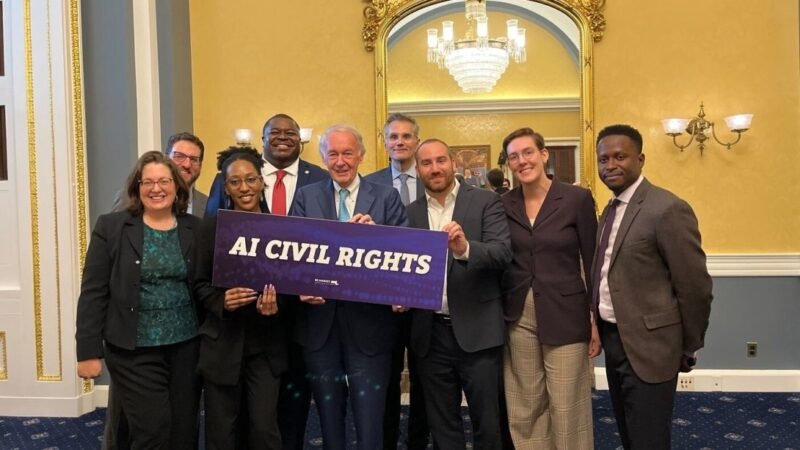
Senator Edward Markey’s AI Civil Rights Act represents the most ambitious legislative effort to date to address algorithmic discrimination. Introduced with growing bipartisan support, the bill has garnered endorsements from over 80 civil rights, labor, and advocacy organizations.
“Just as the struggles of the civil rights movement gave rise to groundbreaking civil rights laws, the harms resulting from the unregulated use of AI and other algorithmic tools demand passing new legislation now. The AI Civil Rights Act is first-of-its-kind legislation that takes a comprehensive approach to regulating AI across sectors.”
Key Provisions of the AI Civil Rights Act
The legislation takes a comprehensive approach to algorithmic accountability, establishing requirements that would fundamentally change how AI systems are developed, deployed, and monitored in consequential decision-making contexts.
AI Civil Rights Act: Core Framework
🚫 Prohibition
Bans the use of AI systems that discriminate based on protected characteristics or cause disparate impact
🔍 Auditing
Requires independent pre-deployment evaluations and post-deployment impact assessments
📊 Transparency
Mandates public disclosure of audit results and algorithmic decision-making processes
⚖️ Accountability
Establishes liability frameworks for both AI developers and deploying organizations
The legislation specifically targets “covered algorithms” involved in consequential decisions affecting people’s rights, civil liberties, and livelihoods. This includes systems used in employment, banking, healthcare, criminal justice, public accommodations, and government services.
Growing Congressional Support
The AI Civil Rights Act has gained significant momentum, with 54 new endorsements from organizations representing diverse constituencies including disability rights advocates, labor unions, and civil liberties groups. Senator Mazie Hirono of Hawaii has joined as a co-sponsor, signaling growing bipartisan recognition of the issue.
California Leads: The Nation’s First AI Employment Discrimination Regulations
While federal legislation moves through Congress, California has taken decisive action. The state’s Civil Rights Council approved groundbreaking regulations that will take effect on October 1, 2025, making California the first state to specifically regulate AI use in employment decisions.
📅 California’s AI Employment Timeline
- May 2024: Initial regulations proposed
- June 27, 2025: Final regulations approved by Office of Administrative Law
- October 1, 2025: Regulations take full effect
- Impact: First comprehensive state-level AI employment discrimination framework
The California regulations establish clear standards for what constitutes discriminatory use of automated decision systems (ADS) in employment contexts. The regulations clarify the application of existing antidiscrimination laws in the workplace in the context of new and emerging technologies, like artificial intelligence.
Key Requirements for California Employers
Under the new regulations, covered entities must meet several stringent requirements when using AI in employment decisions:
🔍 Due Diligence Testing
Employers must conduct anti-bias testing before deployment. Lack of testing becomes relevant evidence in discrimination claims.
📁 Record Retention
All personnel records and ADS data must be retained for four years, enabling thorough bias auditing and compliance monitoring.
🚨 Expanded Protected Classes
Prohibits discrimination based on accent, English proficiency, height, or weight in addition to traditional protected characteristics.
Documented Cases: When Algorithms Discriminate
The impact of algorithmic bias isn’t theoretical—it’s documented in court cases, research studies, and regulatory enforcement actions that reveal the systematic nature of AI discrimination.
The Workday Investigation: A Landmark Case
The Equal Employment Opportunity Commission’s investigation into Workday’s AI recruiting tools represents a watershed moment in AI civil rights enforcement. The case explores whether software vendors can be held liable as “employment agencies” when their tools produce discriminatory outcomes.
“Tests could violate the federal anti-discrimination laws if they disproportionately exclude people in a particular group by race, sex, or another covered basis, unless the employer can justify the test or procedure under the law.”
The Workday case has broader implications for the entire AI industry, potentially establishing precedent that software companies can be held directly liable for discriminatory outcomes produced by their algorithms.
Housing Discrimination Through AI
The Department of Justice’s Statement of Interest in Louis et al. v. SafeRent et al. demonstrates how AI bias extends beyond employment into housing discrimination. The complaint alleged that SafeRent provides tenants screening services that discriminate against Black and Hispanic rental applicants who use federally-funded housing choice vouchers.
📋 Documented AI Discrimination Cases
Microsoft Settlement (2021)
Issue: Employment eligibility verification software discriminated against non-U.S. citizens
Outcome: Settlement with Civil Rights Division for pattern of unfair documentary practices
Georgia Tech Platform (2022)
Issue: Online recruitment platforms excluded non-U.S. citizens from job advertisements
Outcome: Settlements with 16 employers using discriminatory recruitment algorithms
Ascension Health (2021)
Issue: Employment verification software improperly programmed for documentary practices
Outcome: Settlement for pattern of unfair practices in employment verification
⚠️ What AI discrimination patterns concern you most? Whether in hiring, lending, or other areas where algorithms make decisions about people’s lives? Tell us which sectors need the most urgent attention – your priorities could influence policy discussions.
Business Impact: Navigating the New AI Compliance Landscape
For business leaders and HR professionals, the emerging AI civil rights landscape presents both challenges and opportunities. Companies that proactively address algorithmic bias can gain competitive advantages while avoiding legal risks.
The Compliance Imperative
Organizations using AI in hiring, lending, or other consequential decisions face a rapidly evolving regulatory environment. The patchwork of federal guidance, state regulations, and pending legislation creates compliance challenges that require immediate attention.
AI Compliance Requirements by Jurisdiction
| Jurisdiction | Status | Key Requirements | Effective Date |
|---|---|---|---|
| Federal (Markey Act) | Proposed | Pre/post-deployment audits, bias mitigation, transparency | TBD |
| California | Approved | Anti-bias testing, 4-year record retention, expanded protections | Oct 1, 2025 |
| Colorado | Active | AI disclosure requirements, algorithmic bias limits | Active |
| EEOC Guidelines | Active | Disability accommodation, testing validation, documentation | Active |
Financial Implications of AI Bias
The cost of algorithmic discrimination extends far beyond legal settlements. Companies face reputational damage, talent acquisition challenges, and lost business opportunities when AI systems produce discriminatory outcomes.
🎯 Ready to Audit Your AI Systems?
Don’t wait for regulations to force compliance. Learn how leading companies are proactively addressing AI bias with comprehensive AI governance frameworks that protect both business interests and civil rights.
Implementation Guide: Building Bias-Resistant AI Systems
Organizations serious about preventing algorithmic discrimination must move beyond compliance to embrace comprehensive bias mitigation strategies. This requires technical, organizational, and policy interventions.
The Four-Pillar Approach to AI Fairness
Leading organizations are implementing holistic approaches to AI bias prevention that address technical, organizational, legal, and ethical dimensions simultaneously.
Comprehensive AI Bias Prevention Framework
Technical
Diverse training data, bias detection algorithms, fairness metrics integration
Organizational
Diverse development teams, ethics boards, continuous monitoring processes
Legal
Compliance frameworks, audit documentation, liability management
Ethical
Values alignment, stakeholder engagement, impact assessment
Practical Implementation Steps
Organizations can begin addressing AI bias immediately by implementing systematic approaches to algorithmic accountability. The key is to start with assessment and build comprehensive governance structures over time.
AI Bias Mitigation Implementation Timeline
Inventory all AI systems, assess current bias risks, establish baseline metrics for fairness evaluation
Create AI governance policies, establish ethics review board, implement bias testing protocols
Deploy bias detection tools, train staff on fair AI practices, implement monitoring systems
Regular bias audits, stakeholder feedback integration, compliance with emerging regulations
The Future of AI Civil Rights: Beyond Compliance to Justice
The current legislative and regulatory responses to AI bias represent just the beginning of a broader transformation in how society governs algorithmic decision-making. Future developments will likely expand beyond employment and housing to encompass healthcare, education, and social services.
Emerging Trends in AI Governance
Several key trends are shaping the future of AI civil rights enforcement and corporate accountability:
Algorithmic Auditing
Independent third-party auditing of AI systems is becoming standard practice, with specialized firms emerging to provide bias assessment services.
Liability Frameworks
New legal frameworks are emerging to establish clear liability chains from AI developers to deploying organizations to affected individuals.
International Coordination
Cross-border AI governance frameworks are developing to address global algorithmic systems that operate across jurisdictions.
The Business Case for Proactive AI Ethics
Forward-thinking organizations are discovering that comprehensive AI bias prevention isn’t just about legal compliance—it’s about building sustainable competitive advantages through fair and effective algorithmic systems.
“We can have an AI revolution, while also protecting the civil rights and liberties of everyday Americans. We can support innovation without supercharging bias and discrimination. And we can promote competition, while safeguarding people’s rights.”
Organizations that embrace algorithmic fairness early are positioning themselves as leaders in the responsible AI movement while building systems that better serve diverse customers and communities.
🚀 What’s your organization’s biggest AI governance challenge? Whether it’s understanding compliance requirements, implementing bias testing, or building ethical frameworks? Share your specific challenges below – the community might have practical solutions and resources to help.
Conclusion: The Civil Rights Imperative of Our Digital Age
The fight against algorithmic discrimination represents more than a compliance challenge or regulatory requirement—it embodies the fundamental question of whether our technological advancement will enhance or undermine human dignity and equality.
Senator Markey’s AI Civil Rights Act, California’s pioneering regulations, and the growing body of case law all point toward a future where algorithmic accountability becomes as fundamental to business operations as financial auditing or workplace safety standards.
For business leaders, the message is clear: the era of “algorithmic immunity” is ending. Organizations that proactively address AI bias will thrive in a future where fairness, transparency, and accountability become competitive advantages. Those that wait for enforcement actions may find themselves on the wrong side of history—and the law.
The civil rights movement of the digital age has begun. The question isn’t whether algorithmic discrimination will be regulated, but whether your organization will lead the transformation toward fair and just AI systems or be dragged reluctantly into compliance.
The future of AI is being written today.
Will your organization’s algorithms be part of the solution to discrimination, or part of the problem?
Frequently Asked Questions
What is the AI Civil Rights Act?
The AI Civil Rights Act, introduced by Senator Edward Markey, is comprehensive legislation designed to eliminate bias and discrimination in AI systems. It prohibits discriminatory algorithmic decision-making in employment, housing, healthcare, and other critical areas while requiring pre-deployment audits and post-deployment assessments.
How does AI bias affect hiring decisions?
AI bias in hiring can systematically exclude qualified candidates based on race, gender, age, or other protected characteristics. Studies show AI hiring tools have rejected female candidates by mimicking male-dominated workforces and directed job ads based on racial stereotypes. This perpetuates historical discrimination at digital speed and scale.
What are automated decision systems in employment?
Automated decision systems (ADS) are AI-powered tools used for recruitment, hiring, performance evaluation, and promotion decisions. These systems use algorithms to screen resumes, conduct initial interviews, assess skills, and make employment recommendations. California’s new regulations specifically target these systems.
When do California’s AI employment regulations take effect?
California’s AI employment discrimination regulations take effect on October 1, 2025. These regulations require employers to conduct anti-bias testing, retain records for four years, and prohibit discrimination based on expanded protected characteristics including accent and English proficiency.
How can businesses prepare for AI bias regulations?
Businesses should start by auditing existing AI systems for bias, implementing diverse training data practices, establishing AI ethics boards, documenting all algorithmic decisions, and creating transparent bias testing protocols. Proactive compliance is more cost-effective than reactive remediation.
What industries are most affected by AI discrimination concerns?
Employment, housing, financial services, healthcare, and criminal justice are the most impacted sectors. These industries use AI for consequential decisions affecting people’s livelihoods, access to services, and civil rights, making bias prevention critical for legal compliance and ethical operations.
✅ Sources
- Senator Markey’s AI Civil Rights Act Press Release
- California Civil Rights Department: AI Employment Regulations
- European Commission: Human-AI Interaction and Discrimination Study
- Department of Justice Civil Rights Division: AI and Civil Rights
- American Bar Association: EEOC Regulation of Algorithmic Bias
- IEEE Technology and Society: Bias and Discrimination in AI
- MDPI Study: Fairness and Bias in Artificial Intelligence
- UN Women: How AI Reinforces Gender Bias
- PMC: AI Bias Solutions from Pharmaceutical Industry Models
- Hunton Legal Analysis: California AI Employment Regulations
💬 Join the AI Civil Rights Discussion
What’s your perspective on responsible AI development? Have you experienced algorithmic bias in hiring, lending, or other areas? How should we balance innovation with civil rights protection? Your insights could help shape the future of AI governance.
Share your thoughts, experiences, and questions below. Together, we can build a future where AI serves justice, not discrimination.