AI Weekly Roundup: GPT-5 Launch, $152M Federal AI Investment & Enterprise Market Shifts – August 16, 2025

🚀 TL;DR: This Week’s AI Transformation
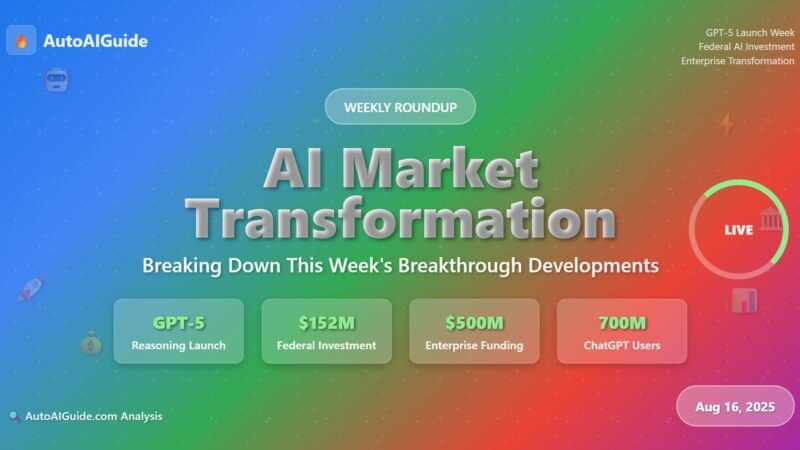
The AI landscape experienced seismic shifts this week. OpenAI launched GPT-5 with unprecedented reasoning capabilities, the U.S. government committed $152 million to open AI research through an NSF-NVIDIA partnership, and enterprise adoption concerns emerged as Cohere raised $500 million. Navigate to the sections that matter most to your business:
🤖 GPT-5: The Most Significant AI Launch of 2025
August 7, 2025 marked a watershed moment in AI development as OpenAI officially launched GPT-5, making it available to all ChatGPT users including free tier subscribers. This represents the first time a reasoning-capable model has been democratically accessible, fundamentally shifting the AI landscape.
GPT-5’s Technical Breakthroughs
GPT-5 integrates advanced reasoning capabilities directly into the base model, eliminating the need to switch between specialized models for different tasks. The implications for business automation are profound:
Reasoning Integration
Built-in thinking capabilities allow GPT-5 to tackle complex multi-step problems without external reasoning models. With thinking enabled, responses are 80% less likely to contain factual errors than OpenAI’s o3 model.
Coding Excellence
GPT-5 achieved state-of-the-art performance on coding benchmarks, scoring 74.9% on SWE-bench Verified and 88% on Aider polyglot. Early testers report it can create functional apps from single prompts.
Enterprise Impact
Companies like BNY, California State University, Figma, Intercom, Lowe’s, Morgan Stanley, SoftBank, and T-Mobile have already integrated ChatGPT business products into their workflows.
Market Response and Enterprise Adoption
OpenAI expects to hit 700 million weekly active ChatGPT users this week and is in talks with investors about a potential stock sale at roughly $500 billion valuation. This astronomical valuation reflects the market’s confidence in GPT-5’s transformative potential.
“I tried going back to GPT-4, and it was quite miserable,” OpenAI CEO Sam Altman said in a briefing with reporters. This candid admission reveals the substantial capability gap between generations.
🚀 How is GPT-5 already changing your business workflows? Are you seeing productivity gains or new automation opportunities? Share your early experiences – the AutoAIGuide community wants to learn from your real-world implementation.
🏛️ Federal Government Commits $152M to Open AI Research
In a strategic move to maintain American AI leadership, the U.S. National Science Foundation announced a partnership with NVIDIA, with NSF contributing $75 million and NVIDIA providing an additional $77 million, to support the Open Multimodal AI Infrastructure to Accelerate Science (OMAI) project.
Strategic Implications for U.S. AI Dominance
This public-private investment advances priorities set forth in the White House AI Action Plan to accelerate AI-enabled science and ensure the United States is producing the leading open models that enhance America’s global AI dominance.
The partnership addresses a critical gap in AI research funding. The cost of creating and researching powerful AI models has grown beyond the budgets of university labs and federally funded researchers, limiting the topics that academic researchers can explore.
Research Focus Areas
AI-accelerated discovery of new materials for energy storage, semiconductors, and sustainable technologies.
Improved protein function prediction for drug discovery and personalized medicine breakthroughs.
Creating fully open-source, multimodal large language models trained on scientific data and literature.
Allen Institute for AI Leadership
The collaboration will create a fully open suite of advanced AI models specifically designed to support the U.S. scientific community, led by the Allen Institute for AI (Ai2). This choice signals the government’s commitment to democratizing AI research rather than concentrating power in a few tech giants.
“Fully-open AI is not just a preference — it’s a necessity,” said Ali Farhadi, CEO of Ai2. “For the U.S. to continue leading the next era of scientific and technological discovery, we must create open, collaborative ecosystems where millions of researchers and developers can work together.”
This contrasts sharply with the closed-source approach dominating commercial AI development, suggesting a strategic bifurcation between proprietary enterprise AI and open scientific research models. For businesses, this means access to cutting-edge research tools without commercial licensing restrictions.
💰 Enterprise AI Funding Surge: Cohere’s $500M Round
Enterprise GenAI unicorn Cohere secured $500 million in a new funding round to scale its AI platform for large organizations, with the company aiming to enhance AI integration for business analytics, customer support, and automation.
| Company | Funding Amount | Focus Area | Market Position |
|---|---|---|---|
| Cohere | $500M | Enterprise AI | Leading B2B |
| OpenAI | $500B valuation | Consumer + Enterprise | Market Leader |
| Anthropic | $60B+ rumored | Safety-focused AI | Rising Fast |
Cohere
OpenAI
Anthropic
Enterprise AI Market Dynamics
Cohere’s massive funding round signals investors’ confidence in the enterprise AI market, particularly for companies focusing on business-specific use cases rather than consumer applications. The company aims to enhance AI integration for business analytics, customer support, and automation, with plans for global expansion and further development of proprietary models.
This funding environment reflects a maturation of the AI market, where specialized enterprise players can command significant valuations independent of the consumer-focused giants. For AutoAIGuide readers building AI-powered businesses, this suggests robust venture appetite for proven B2B AI solutions.
💼 Which enterprise AI tools are you evaluating for 2025? Cohere’s funding success shows investors are betting big on B2B AI. Tell us about your AI procurement strategy – are you seeing similar enterprise-focused solutions in your industry?
📊 AI Employment Impact: Critical Market Analysis
This week brought sobering insights into AI’s employment implications. Cisco’s president rejects doomsday warnings from some tech leaders that artificial intelligence will make entry-level jobs vanish, but economists say there are early signs suggesting AI may already be depressing entry-level jobs.
The Entry-Level Job Market Reality
🚨 Critical Employment Statistics
The Class of 2025 faces the worst job market for new college graduates in years, with entry-level hiring tumbling by 23% between March 2020 and May 2025, outpacing the 18% decline in overall hiring.
Industry Leader Perspectives
While Cisco’s president acknowledged there will be “growing pains where people will get disrupted,” he strongly pushed back on Anthropic CEO Dario Amodei’s comments saying AI will spike unemployment to as high as 20% and eliminate half of all white-collar entry level jobs.
This disagreement highlights the uncertainty even among industry leaders about AI’s employment trajectory. For businesses, this suggests the need for balanced workforce planning that accounts for both AI augmentation and potential displacement.
Strategic Workforce Implications
The employment data suggests AI adoption may be following a pattern where routine entry-level tasks become automated first, while more complex roles remain stable. This has profound implications for:
- Hiring strategies: Companies may need to recruit for different skill sets than previously required
- Training programs: Investment in AI literacy and human-AI collaboration skills becomes critical
- Workforce planning: Balancing automation benefits with employment responsibilities
For solopreneurs and small businesses, this environment presents opportunities to compete with larger organizations by leveraging AI tools to achieve greater productivity per employee. Our previous analysis on AI automation for solopreneurs becomes even more relevant in this context.
🔮 Strategic Implications: What This Week Means for Your Business
The New AI Competitive Landscape
This week’s developments fundamentally alter the AI competitive landscape. GPT-5’s democratized access to reasoning capabilities, combined with substantial federal investment in open research, creates new opportunities for businesses of all sizes.
Immediate Opportunities
Days to GPT-5 Integration
Action Items
• Audit current AI workflows for GPT-5 upgrade potential
• Test reasoning capabilities on complex business problems
• Evaluate cost savings from consolidated model usage
• Train teams on advanced prompting techniques
Federal Research Access
Open Models Available
Strategic Considerations
• Monitor open model releases for cost-effective alternatives
• Consider partnerships with research institutions
• Evaluate open-source integration opportunities
• Plan for reduced dependence on proprietary models
Workforce Evolution
Entry-Level Job Decline
Adaptation Strategies
• Redesign entry-level roles to focus on AI collaboration
• Invest in upskilling existing workforce
• Develop AI-augmented productivity metrics
• Create new value-added human roles
Investment and Funding Landscape
The massive funding rounds this week (Cohere’s $500M, OpenAI’s $500B valuation discussions, potential Anthropic $60B+ round) indicate unprecedented investor confidence in AI’s commercial viability. This creates opportunities for:
- AI-powered startups: Venture appetite remains strong for differentiated AI applications
- Enterprise tools: B2B AI solutions command premium valuations
- Integration services: Growing demand for AI implementation consulting
Cross-Platform Strategy Considerations
With GPT-5, Google’s Gemini education tools, and Anthropic’s Claude 4 advances all launching simultaneously, businesses must navigate an increasingly complex multi-model landscape. Our analysis of Google’s AI developments and agentic AI systems provides additional context for multi-platform strategies.
🎯 What’s your biggest AI integration challenge right now? This week’s launches create new possibilities but also complexity. Share your multi-model strategy – the community benefits from your real-world experience navigating these choices.
🌍 Global AI Competition Intensifies
Beyond the immediate product launches, this week’s developments reveal intensifying global AI competition. The NSF-NVIDIA partnership explicitly aims to ensure American AI dominance, while AI-powered browser assistants are causing alarm over potential privacy violations, with experts warning these tools could expose users to surveillance and data misuse.
This privacy scrutiny, combined with the federal government’s commitment to open research models, suggests a potential decoupling between consumer AI (dominated by commercial giants) and research/enterprise AI (increasingly open and government-supported).
Looking Ahead: Key Metrics to Watch
📈 The Week Ahead: What to Monitor
As we close this transformative week in AI development, several trends warrant close observation:
- GPT-5 adoption rates: How quickly enterprises migrate from GPT-4 to GPT-5
- Competitive responses: How Google, Anthropic, and others respond to GPT-5’s capabilities
- Open model development: Progress on the NSF-NVIDIA research initiative
- Employment indicators: Further data on AI’s impact on entry-level hiring
- Enterprise spending: Whether the $500M+ funding rounds indicate broader enterprise AI investment increases
The convergence of breakthrough model capabilities, massive funding, federal investment, and workforce concerns creates an unprecedented inflection point in AI adoption. Businesses that act strategically in this window may gain sustainable competitive advantages.
🚀 Stay Ahead of the AI Curve
This week’s developments are just the beginning. AI advancement is accelerating faster than ever, and staying informed isn’t optional—it’s essential for business survival and growth.
Don’t miss critical AI developments that could transform your industry. Get weekly analysis delivered directly to your inbox.
🔗 Essential Sources & Further Reading
Primary Sources
💬 What’s your take on this week’s biggest AI developments? Are you excited about GPT-5’s reasoning capabilities, concerned about the employment implications, or planning to leverage the federal research investment? Join the discussion below and share how these changes will impact your business strategy.