
Meta’s AI Revolution: How Full Advertising Automation by 2026 Will Transform Marketing Forever

🎯 TL;DR: Meta’s AI Revolution is Here
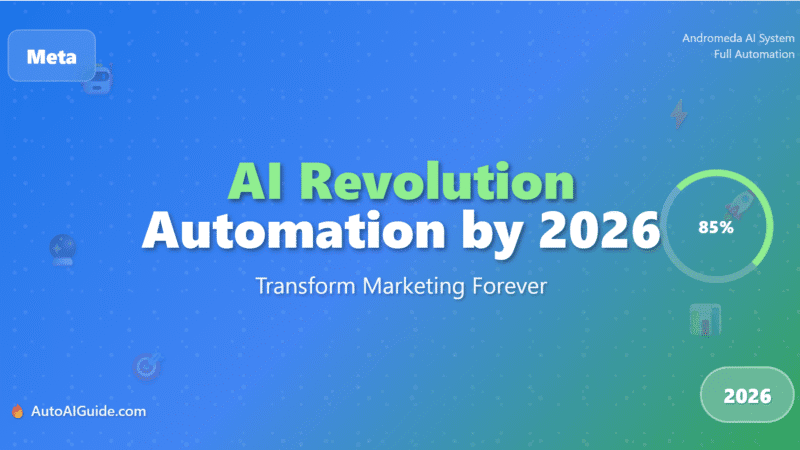
Meta is racing toward fully automated advertising by 2026 – where marketers will simply input a business URL and budget, while AI handles everything else. Their new Andromeda system already analyzes tens of millions of ads to deliver 22% higher ROAS, and over 1 million advertisers are using their AI tools to create 15 million ads monthly.
Quick Navigation:
The advertising world is witnessing the most significant transformation since the dawn of digital marketing. Meta’s latest announcement about achieving full advertising automation by 2026 isn’t just another tech update—it’s a fundamental shift that will redefine how businesses approach marketing entirely.
While many marketers are still grappling with AI agents like HubSpot’s Breeze, Meta is leaping ahead with technology that promises to eliminate manual campaign management altogether. Their new Andromeda AI system is already analyzing tens of millions of ads in real-time, delivering results that consistently outperform human-managed campaigns.
🤔 Are you ready for a world where AI manages your entire advertising strategy? What concerns do you have about giving up campaign control to algorithms? Share your thoughts – your insights could help shape how the industry adapts to this massive change.
🤖 Meta’s Andromeda: The Brain Behind the Revolution
At the heart of Meta’s advertising transformation is Andromeda, a proprietary machine learning system that represents a quantum leap in ad personalization technology. Built on NVIDIA Grace Hopper Superchips and Meta’s own Training and Inference Accelerator (MTIA) hardware, Andromeda processes advertising decisions at a scale and speed that was previously unimaginable.
How Andromeda Actually Works
Unlike traditional ad targeting systems that rely on predefined parameters, Andromeda operates as a real-time learning machine. It continuously analyzes user behavior patterns, ad performance metrics, and contextual signals across Facebook, Instagram, and soon Threads to make split-second decisions about which ads to show to which users.
“Using the ad tools Meta is developing, a brand could present an image of the product it wants to promote along with a budgetary goal, and AI would create the entire ad, including imagery, video and text. The system would then decide which Instagram and Facebook users to target.”
The system’s sophistication extends beyond simple targeting. Andromeda can now:
- Generate multiple creative variations automatically, testing different backgrounds, copy, and formats
- Predict user intent based on micro-behaviors and engagement patterns
- Optimize budget allocation in real-time across different audience segments
- Personalize ad content for individual users at scale
🔍 AI vs Manual Campaign Performance
📅 The Road to 2026: Meta’s Automation Timeline
Meta’s journey toward full automation isn’t happening overnight. The company has been methodically building toward this moment through a series of strategic releases and improvements that have progressively reduced the need for human intervention in campaign management.
Meta’s AI Evolution Timeline
Initial AI-powered campaign optimization for shopping ads
Generative AI for ad creative and background editing
Deep neural networks for personalized ad retrieval at scale
Opportunity Score and real-time recommendations
Goal-only campaigns with minimal human input required
What “Full Automation” Actually Means
By 2026, Meta envisions a system where businesses can launch sophisticated advertising campaigns with just three inputs:
- Business URL – Meta’s AI will crawl and understand your business
- Marketing Objective – Whether you want sales, leads, or brand awareness
- Budget Parameters – Your total spend and timeline preferences
The AI will then handle everything else: audience research, creative development, placement optimization, bid management, and performance reporting. This represents a fundamental shift from the current model where marketers must make hundreds of decisions for each campaign.
💡 But here’s the critical question: Will this level of automation actually improve results for your business, or will it commoditize advertising strategies? Let us know – are you excited or concerned about this level of AI control?
📊 The Numbers Don’t Lie: AI is Already Winning
While the promise of 2026 full automation might sound futuristic, Meta’s current AI tools are already delivering measurable results that surpass traditional campaign management. The data from early adopters and beta testers reveals a consistent pattern: AI-driven campaigns consistently outperform manual ones across virtually every meaningful metric.
ROAS Performance
Advantage+ campaigns are delivering significantly higher returns on ad spend compared to manual campaigns.
Cost Efficiency
AI optimization is reducing acquisition costs while maintaining or improving lead quality.
Creative Performance
AI-generated creative variations are significantly outperforming manually created ads.
Real-World Case Studies
The performance improvements aren’t just theoretical. Companies that have embraced Meta’s AI tools are reporting transformational results:
- UK Jewelry Brand: Achieved a 35.78% decrease in Cost Per Acquisition and 53.27% increase in ROAS after implementing Advantage+ campaigns
- E-commerce Retailer: Saw 23% improvement in ROAS and 67.8% rise in purchases using AI optimization tools
- Service Business: Reported 83% ROAS improvement in the first week of using AI recommendations
“Almost all our advertisers are using one of our AI-powered tools and adoption of Advantage+ shopping campaigns continues to scale—growing revenue 70% YOY in Q4.”
🌍 Beyond Meta: How AI is Reshaping the Entire Advertising Landscape
Meta’s push toward automation isn’t happening in isolation. The entire digital advertising ecosystem is experiencing a fundamental transformation as AI technologies mature and become more accessible. What we’re witnessing is the beginning of a new era where human creativity partners with machine intelligence to create advertising strategies that were previously impossible.
The global AI marketing market has exploded from $15.84 billion in 2021 to $47.32 billion in 2025, with projections reaching $107.5 billion by 2028. This isn’t just growth—it’s a fundamental restructuring of how marketing budgets are allocated and campaigns are executed.
🏭 AI Adoption Rates by Industry (2025)
| Industry | AI Adoption Rate | Primary Use Case | Average ROI Increase |
|---|---|---|---|
| Healthcare | 90% | Patient targeting | +28% |
| Financial Services | 82% | Risk assessment | +24% |
| SaaS/Technology | 75% | Lead scoring | +31% |
| E-commerce | 71% | Personalization | +26% |
| Manufacturing | 58% | B2B targeting | +18% |
| Traditional Retail | 54% | Local advertising | +15% |
Healthcare
Financial Services
SaaS/Technology
E-commerce
Manufacturing
Traditional Retail
The Broader Automation Trend
Meta’s automation strategy aligns with a broader industry movement toward intelligent advertising systems. Companies like Google have been developing similar capabilities, while emerging platforms are building AI-first advertising solutions from the ground up. This convergence suggests that by 2030, manual campaign management may become as obsolete as hand-coding websites.
The implications extend far beyond individual platforms. As agentic AI systems become more sophisticated, we’re likely to see the emergence of cross-platform optimization that manages campaigns across multiple channels simultaneously—something that would be impossible for human marketers to execute effectively.
🚀 Preparing for the AI-First Advertising Future
The transition to AI-dominated advertising isn’t a distant future scenario—it’s happening now. Smart marketers and business owners are already positioning themselves to thrive in this new landscape. The key is understanding that this shift requires more than just adopting new tools; it demands a fundamental rethinking of marketing strategy and skills.
Essential Steps for 2025 and Beyond
Master First-Party Data
Essential foundation for AI success:
- Clean, organize customer data across touchpoints
- Implement proper attribution tracking
- Build comprehensive customer profiles
- Ensure privacy compliance (GDPR, CCPA)
- Create data-rich feedback loops for AI
Develop AI Literacy
Critical AI skills for marketers:
- Understanding algorithm optimization principles
- Data interpretation and analysis
- AI tool selection and evaluation
- Performance monitoring and adjustment
- Creative prompt engineering for AI
Test Hybrid Approaches
Balanced automation strategy:
- Use AI for large-scale prospecting
- Maintain manual control for premium segments
- Test different automation levels
- Monitor brand safety and positioning
- Preserve human creativity in strategy
Focus on Creative Quality
Creative excellence in AI era:
- Develop diverse creative assets for testing
- Create user-generated content pipelines
- Build authentic brand storytelling
- Test video-first content strategies
- Maintain brand consistency across variations
The Skills Marketers Need to Develop
As AI handles more tactical execution, human marketers must evolve into strategic orchestrators who can:
- Interpret AI performance data to make strategic decisions
- Manage AI tool ecosystems across multiple platforms
- Maintain brand integrity within automated systems
- Identify automation opportunities and risk areas
- Bridge AI capabilities with business objectives
This evolution mirrors what we’ve seen in other industries. Just as developers had to adapt their skills when AI coding assistants emerged, marketers must now learn to work alongside intelligent systems that can execute campaigns at superhuman scale and speed.
🎯 Here’s the million-dollar question: What specific skills are you focusing on to stay relevant in an AI-first marketing world? Share your learning strategy – let’s help each other navigate this transition successfully.
🔮 The Long-Term Vision: Marketing in 2030
Looking beyond Meta’s 2026 automation milestone, the advertising landscape of 2030 will likely be unrecognizable from today’s manual, platform-by-platform approach. We’re heading toward an era of intelligent marketing orchestration where AI systems manage entire customer journeys across multiple touchpoints, platforms, and lifecycle stages.
What to Expect
Industry experts and early indicators suggest several key developments:
- Cross-Platform Intelligence: AI systems that optimize campaigns across Meta, Google, Amazon, and emerging platforms simultaneously
- Predictive Customer Journey Mapping: AI that anticipates customer needs and pre-positions relevant content and offers
- Dynamic Creative Generation: Real-time content creation that adapts to individual user preferences and context
- Autonomous Budget Allocation: AI that automatically redistributes marketing spend based on real-time performance and market conditions
- Personalized Pricing Strategies: AI-driven dynamic pricing that optimizes for individual customer value and price sensitivity
For solopreneurs and small businesses, this represents an unprecedented democratization of marketing capabilities. What previously required teams of specialists and massive budgets will become accessible through AI-powered platforms that level the playing field. As we’ve discussed in our analysis of AI automation for solopreneurs, these tools are already enabling individual entrepreneurs to compete with much larger organizations.
⚠️ Navigating the Challenges and Risks
While the potential benefits of AI automation are compelling, it’s crucial to acknowledge the significant challenges and risks that come with this transformation. The advertising industry has seen enough “revolutionary” technologies over the years to approach new developments with healthy skepticism.
Key Concerns to Monitor
Brand Safety and Control: As AI systems become more autonomous, maintaining brand consistency and avoiding inappropriate placements becomes more challenging. Early adopters report instances where AI-optimized campaigns delivered excellent metrics but damaged brand perception through poor creative choices or inappropriate audience targeting.
The “Black Box” Problem: As campaigns become more automated, marketers lose visibility into why certain decisions are made. This makes it difficult to learn from successes, replicate strategies, or explain performance to stakeholders. The challenge is particularly acute for brands with strict compliance requirements or those operating in sensitive categories.
Over-Optimization Risk: AI systems excel at optimizing for specific metrics, but they may do so at the expense of broader business objectives. For example, an AI system focused on maximizing clicks might sacrifice lead quality or long-term customer value for short-term engagement metrics.
“The accounts that are crushing it with Advantage Plus Audiences generally have spent a lot more money on Facebook, have a very specific target they’re going for, and have just more data that they’ve been able to give Facebook over time.”
💼 Industry-Specific Implementation Strategies
The path to AI advertising success isn’t one-size-fits-all. Different industries face unique challenges and opportunities when implementing automated advertising systems. Understanding these nuances is crucial for developing effective strategies that align with sector-specific needs and constraints.
Healthcare and Finance: Compliance-First Automation
Highly regulated industries must balance automation benefits with strict compliance requirements. Healthcare and financial services companies are finding success with hybrid approaches that automate routine tasks while maintaining human oversight for sensitive decisions.
- Automated audience research with manual creative approval
- AI-powered bid optimization with compliance guardrails
- Predictive analytics for identifying high-value prospects within regulatory boundaries
E-commerce: Full-Scale Automation
E-commerce businesses are leading the charge in AI adoption, with many already using advanced automation for product catalog management, dynamic pricing, and cross-platform inventory synchronization. These companies benefit most from Meta’s upcoming full automation because their success metrics align closely with what AI systems optimize for naturally.
B2B Services: Strategic Automation
B2B companies face longer sales cycles and more complex decision-making processes, making them ideal candidates for AI-powered lead scoring and nurturing automation. However, they typically require more sophisticated integration with CRM systems and marketing automation platforms.
🎉 The Bottom Line: Embracing the AI Revolution
Meta’s march toward full advertising automation by 2026 represents more than a technological upgrade—it’s a fundamental reshaping of how businesses connect with customers. The companies that will thrive in this new landscape are those that start preparing today, building the data foundations, skills, and strategic frameworks necessary to succeed in an AI-first marketing world.
🚀 Ready to Future-Proof Your Marketing Strategy?
The AI advertising revolution is happening whether we’re ready or not. The question isn’t whether to adopt these technologies, but how quickly and effectively you can integrate them into your marketing operations.
Start building your AI-ready marketing foundation today:
- Audit your current data collection and organization systems
- Test Meta’s existing Advantage+ tools with small budgets
- Develop AI literacy within your marketing team
- Create processes for maintaining brand consistency within automated systems
- Build hybrid strategies that balance automation with human creativity
The transformation we’re witnessing isn’t just about more efficient advertising—it’s about unlocking new possibilities for personalization, creativity, and customer connection that were previously impossible at scale. As we’ve seen with other major technological shifts, the businesses that adapt early and thoughtfully will gain sustainable competitive advantages that last well beyond the initial disruption period.
The future of advertising is being written now, in the decisions we make about how to integrate AI into our marketing strategies. Make sure your business is part of shaping that future rather than simply reacting to it.
📚 Sources & Further Reading
- Meta’s Reportedly Planning to Enable Fully Automated Ad Campaigns by Next Year – Social Media Today
- Meta Andromeda: Supercharging Advantage+ automation – Engineering at Meta
- Meta Rolls Out Updates to Advantage+ AI Ad Targeting Tools – Social Media Today
- Meta doubles down on AI tools to boost ad performance – Campaign Asia
- The State of AI: Global survey – McKinsey
- 50+ AI Marketing Statistics Revealing the Real State of the Industry – SEO.com
- AI Marketing Statistics for 2025: Growth, ROI, Trends & Real-World Impact
- Automation and AI in Marketing Statistics of 2025 – Intelliarts