
The Authenticity Paradox: When AI Content Feels More Human Than Humans – What This Means for Marketing’s Soul

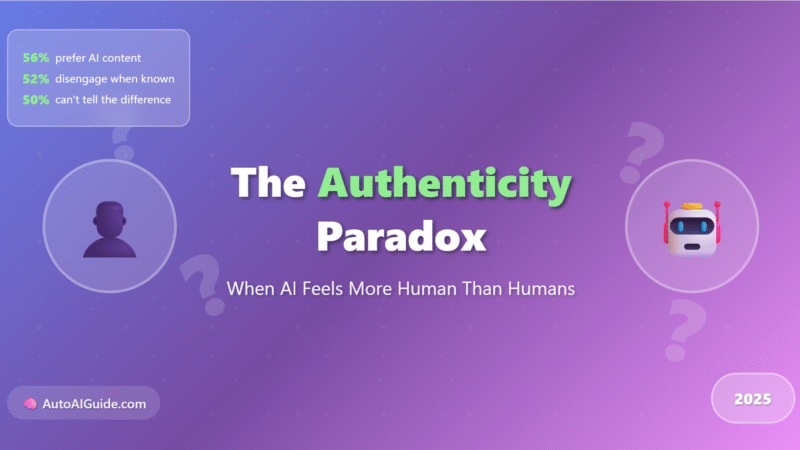
🤯 The Authenticity Paradox: We’re Living in a Philosophical Crisis
Here’s the mind-bending reality: 56% of consumers prefer AI-generated content when they don’t know it’s AI-created, yet 52% feel less engaged when they discover content is machine-generated. Only 50% can even tell the difference between AI and human writing, while scientific studies show AI poetry, essays, and medical literature consistently rated higher than human equivalents. We’ve reached a philosophical inflection point where the question isn’t “Can AI write like humans?” but “What does ‘authentic’ mean when AI writes more human than humans?” This isn’t about marketing tactics—it’s about the fundamental nature of creativity, value, and what we consider “real” in human expression. The implications stretch far beyond content creation to the very soul of what makes marketing meaningful.
🧭 Navigate the Philosophical Landscape
The Paradox Revealed: When Fake Feels More Real Than Real
We are living through the most profound philosophical crisis in marketing’s history, and most of us haven’t even noticed. It’s a crisis that challenges everything we think we know about authenticity, creativity, and human value. The evidence is staring us in the face, impossible to ignore yet difficult to comprehend.
Consider this reality: scientific studies across multiple fields—from medical literature to creative writing—consistently show that humans cannot distinguish AI-generated content from human-created content. In fact, they often rate AI content as superior. ChatGPT essays are rated higher in quality than human essays. Humans can’t tell whether AI or humans wrote medical abstracts. AI-generated poetry is indistinguishable from human poetry and rated more favorably.
“The future of content isn’t a binary battle between robots and humans; it’s an intricate tango where both partners bring their unique talents to the floor.”
But here’s where the paradox deepens: when consumers know content is AI-generated, their entire emotional relationship changes. 52% report feeling less engaged with content they suspect is created by AI, even though they preferred that same content when they believed it was human-created. This isn’t about quality—it’s about meaning, origin, and our fundamental assumptions about what makes communication valuable.
The Quality Versus Origin Dilemma
This creates a philosophical conundrum that goes to the heart of how we value human expression. If AI consistently creates content that humans find more engaging, more coherent, and more emotionally resonant than human-created content, what exactly are we valuing when we insist on “authenticity”? Are we valuing the experience of the content, or the knowledge of its origin?
The Authenticity Paradox: Four Contradictory Truths
Truth #1: Quality Preference
56% prefer AI content when they don’t know it’s AI
Truth #2: Origin Aversion
52% feel less engaged when they know it’s AI-generated
Truth #3: Detection Failure
Only 50% can actually identify AI-generated content
Truth #4: Transparency Desire
63% want AI content to be disclosed, despite preferring it
The Central Question: If we prefer AI content but reject it based on origin, are we valuing the work… or the worker?
This paradox reveals something uncomfortable about human nature. We want to believe our preferences are based on objective quality, but they’re actually rooted in storytelling and mythology. When we know a human wrote something, we bring different expectations, different emotions, different forgiveness to the experience.
I’ve been thinking about this personally. Last month, I read a blog post that moved me to tears—genuinely emotional, beautifully crafted, perfectly timed for what I was going through. I shared it, recommended it, felt grateful to the writer. Two weeks later, I discovered it was AI-generated. My initial reaction? Betrayal. Not because the content had changed, but because my relationship to it had fundamentally shifted.
🎭 Have you ever discovered something you loved was AI-created? How did that revelation change your feelings about the work itself? Share your experience with the authenticity shift – because this psychological phenomenon is reshaping how we value human creativity.
The Detection Problem: Living in Perpetual Uncertainty
Here’s what keeps me awake at night: we’re entering an era where authenticity becomes fundamentally unknowable. The Bynder study showing that only 50% of people can identify AI content isn’t a temporary problem that will be solved with better detection tools. It’s the new permanent condition of human communication.
Think about the implications. Every email you read, every article that resonates with you, every social media post that makes you laugh—you’ll never know with certainty whether it came from human creativity or algorithmic generation. We’re moving from a world of knowable authenticity to a world of perpetual ambiguity.
The Millennials Advantage (For Now)
The research shows that millennials aged 25-34 are currently the best at spotting AI content, which makes sense—we’re the generation straddling analog and digital, old authenticity and new simulation. We remember when “real” was easier to identify. But even we’re only succeeding half the time.
What’s particularly fascinating is the generational split. While millennials are better at detection, Gen Z (16-24) was the only group to prefer human-written content when given a choice. They’re digital natives, but they’re also the generation most skeptical of artificial authenticity. Maybe growing up with social media filters and Instagram facades made them more hungry for genuine human expression.
The Impossibility of Perfect Detection
But here’s the crucial point: even if detection tools improve, we’re fighting a losing battle. For every advancement in AI detection, there will be corresponding improvements in AI generation. We’re not moving toward a world where we can reliably identify AI content—we’re moving toward a world where that distinction becomes meaningless.
This isn’t a technological problem to be solved. It’s a fundamental shift in the nature of human communication. We’re transitioning from an era where authenticity was verifiable to an era where authenticity becomes a matter of faith, trust, and personal choice.
The Great Contradiction: Why We Want What We Reject
The most psychologically complex aspect of this paradox is the contradiction between our revealed preferences and our stated values. When we don’t know the source, we choose AI content 56% of the time. When we do know the source, 52% of us become less engaged with the exact same content.
This reveals something profound about human psychology: we’re not really evaluating content based on its inherent qualities. We’re evaluating it based on the story we tell ourselves about its origins. And that story matters more than we’d like to admit.
“As humans, we all crave emotional connections, and as marketers, we know it is our role to evoke emotions and tell compelling narratives. Interestingly, when participants had to choose between two articles without knowing which was AI-generated, 56% expressed their preference for the AI-authored version.”
The Psychological Mechanics of Preference
I think what’s happening here goes deeper than simple bias. When we read content knowing it’s human-created, we bring empathy, understanding, and emotional connection to the experience. We imagine the writer’s struggle, their expertise, their personality. We read not just the words, but the story of human effort behind them.
When we learn content is AI-generated, that entire emotional framework collapses. We’re not just reading different words—we’re reading with a completely different psychological apparatus. The content hasn’t changed, but our relationship to it has been fundamentally altered.
The Psychology of Content Relationship
Reading Human Content
- Emotional connection to creator
- Empathy for struggle/effort
- Story of human experience
- Forgiveness for imperfections
- Projection of personality
Reading AI Content
- Transactional evaluation
- Focus purely on output quality
- No emotional backstory
- Higher standards for perfection
- Cynical analysis of intent
Key Insight: We don’t just read content—we read the story of its creation. AI challenges our fundamental relationship with creative expression.
This psychological shift has massive implications for marketers. It suggests that the value of content isn’t just in its quality, but in the perceived humanity behind it. We’re not just buying products or services—we’re buying relationships, stories, and connections to other human beings.
What Does ‘Authentic’ Even Mean Anymore?
Let’s get philosophical for a moment. What exactly do we mean when we talk about “authenticity”? The word has become so overused in marketing that it’s almost meaningless, but the AI revolution forces us to grapple with its real definition.
Is authenticity about origin—who or what created something? Is it about intention—the purpose behind creation? Is it about experience—how something affects us emotionally? Or is it about transparency—knowing the full story of how something came to be?
The Shifting Definition of “Real”
I’ve been wrestling with this personally. When I use AI to help research an article, edit my writing, or generate ideas, am I being less authentic? When AI helps me express thoughts I genuinely have but struggle to articulate, is the result less “real”? When it helps me write better emails to customers, am I being dishonest about my communication abilities?
The more I think about it, the more I realize authenticity might not be about the tools we use—it’s about the intention behind them. A photographer using Photoshop isn’t necessarily less authentic than one using only natural light. A musician using synthesizers isn’t less genuine than one using only acoustic instruments. Maybe the question isn’t whether we use AI, but how and why we use it.
🤖 The Authenticity Redefinition Challenge
As AI becomes indistinguishable from human creativity, we need new frameworks for thinking about authenticity in marketing. It’s not about avoiding AI—it’s about using it in ways that enhance rather than replace genuine human insight and connection. The brands that figure this out first will define the future of meaningful communication. Explore how autonomous marketing systems are already changing these dynamics.
Four Emerging Models of Authenticity
Based on my observations of how different companies and creators are handling this, I see four distinct approaches to authenticity in the AI era:
1. Purist Authenticity: Reject AI entirely, emphasize human craftsmanship. This is the “artisanal” approach—slower, more expensive, but appeals to consumers who value traditional human creation. Some brands are even marketing themselves as “AI-free.”
2. Transparent Collaboration: Use AI openly, but maintain human oversight and decision-making. Disclose AI involvement while emphasizing human curation, editing, and strategic thinking.
3. Enhanced Authenticity: Use AI to amplify human capabilities rather than replace them. AI helps with research, ideation, and optimization, but core insights and creativity remain human-driven.
4. Post-Authentic Marketing: Embrace the fact that origin doesn’t matter—focus purely on value, impact, and results. If AI creates better content, use it without apology or extensive disclosure.
Each approach has merits, and I suspect different brands will succeed with different strategies depending on their audience, values, and market position.
The Emotional Complexity of AI Relationships
Here’s something I find fascinating about the research: consumers’ emotional responses to AI content vary dramatically based on context and emotional state. When people are angry, they prefer to vent to humans rather than chatbots. But when they’re embarrassed, they actually prefer AI interactions to avoid human judgment.
This suggests that our relationship with AI authenticity isn’t binary—it’s contextual and emotional. Sometimes we want the efficiency and non-judgmental nature of AI. Sometimes we crave the empathy and understanding that we believe only comes from human connection.
The Embarrassment Factor
I think the embarrassment finding is particularly revealing. When we’re vulnerable or ashamed, AI can feel safer than human interaction. There’s no judgment, no social consequences, no need to manage someone else’s emotional response to our situation. In these moments, AI’s lack of humanity becomes a feature, not a bug.
This opens up interesting possibilities for marketing. Maybe the future isn’t about making AI seem more human—maybe it’s about being strategic about when we emphasize AI’s artificial nature and when we emphasize human involvement.
When Consumers Prefer AI vs Human Interaction
Prefer AI When:
- Feeling embarrassed or ashamed
- Need quick, efficient answers
- Want to avoid social judgment
- Dealing with sensitive topics
- Need 24/7 availability
Prefer Human When:
- Feeling angry or frustrated
- Need empathy and understanding
- Want to vent emotions
- Seeking creative inspiration
- Building long-term relationships
The future of authentic marketing may be about emotional intelligence—knowing when to be human and when to be artificial.
🧠 How do you emotionally relate to AI-generated content? Do you feel differently about AI assistance when you’re struggling versus when you’re confident? Share your emotional AI experiences – understanding these patterns could reshape how we design AI-human interactions.
The Future: When Everyone Is Everyone and No One Is Anyone
Looking ahead, I see three possible futures for authenticity in marketing, each with radically different implications for human creativity and business strategy.
Scenario 1: The Transparency Revolution
In this future, we develop sophisticated systems for tracking and disclosing AI involvement in content creation. Every piece of content comes with detailed metadata about its creation process—which parts were AI-generated, which were human-edited, what prompts were used, what training data influenced the output.
This creates a new kind of authenticity based on transparency rather than origin. Consumers can make informed choices about what level of AI involvement they’re comfortable with, and brands compete on their ability to thoughtfully integrate human and artificial intelligence.
Scenario 2: The Post-Authentic Era
Alternatively, we might simply stop caring about origin altogether. If AI consistently produces better content than humans, maybe authenticity becomes about results rather than process. We stop asking “Who wrote this?” and start asking “Does this help me?” “Does this move me?” “Does this solve my problem?”
In this future, the concept of authenticity evolves to mean something like “genuine usefulness” rather than “human-created.” Brands succeed based on their ability to provide value, regardless of how that value is generated.
Scenario 3: The Human Premium
The third possibility is a market segmentation where human-created content becomes a luxury good. Just as handmade products command premium prices in a mass-production world, human-created content might become the artisanal option for consumers willing to pay more for the story of human effort.
This creates two tiers of marketing: efficient, AI-generated content for most consumers, and premium, human-crafted content for those who value the traditional creative process.
Three Possible Futures for Authentic Marketing
Full Disclosure Future
- AI involvement tracked and disclosed
- Consumer choice based on transparency
- New authenticity = honest process
- Brands compete on AI integration wisdom
Results-Only Future
- Origin becomes irrelevant
- Value and usefulness are what matters
- Authenticity = genuine helpfulness
- Best content wins regardless of source
Artisanal Future
- Human-created content as luxury good
- Two-tier market structure
- AI for efficiency, humans for premium
- Story of human effort has economic value
What This Means for Marketers Right Now
Regardless of which future emerges, there are practical implications for how we approach marketing today. First, we need to get comfortable with philosophical ambiguity. The old certainties about authenticity are gone, and we’re in a transitional period where the rules are being rewritten in real-time.
Second, we need to think more deeply about what we’re really selling. Are we selling products, or are we selling relationships? Are we selling information, or are we selling the experience of human connection? The answer will determine how much AI involvement makes sense for our brand.
Finally, we need to experiment thoughtfully. The data suggests that consumers are more sophisticated and more conflicted about AI than we might assume. They want transparency, but they also want quality. They crave human connection, but they prefer AI efficiency. These aren’t contradictions to be resolved—they’re complexities to be navigated.
The Soul of Marketing in an AI World
Ultimately, I think this authenticity paradox is forcing us to confront what marketing is really about. Is marketing about communication? Is it about persuasion? Is it about building relationships? Is it about providing value?
My sense is that the brands and marketers who thrive in this new era will be those who understand that authenticity isn’t about the tools—it’s about the intention. It’s not about whether you use AI—it’s about whether you use it in service of genuine human needs and genuine business value.
The future of authentic marketing might not be about being more human than AI. It might be about being more thoughtful about when to be human, when to be artificial, and how to be transparent about the choice.
🔮 Which future do you think we’re heading toward? Will transparency win, will we stop caring about origin, or will human-created content become a premium product? Share your prediction and reasoning – your perspective could help us all navigate this transformation more thoughtfully.
✅ Sources
- Bynder: How consumers interact with AI vs human content study
- Christopher Penn: Why Consumers Prefer AI Content
- The Drum: From AI to authenticity – Why human connection will drive marketing
- KUNGFU.AI: What Does It Mean to Be “Real” in 2025?
- Harvard Business Review: Research – Consumers Don’t Want AI to Seem Human
- upGrowth: How AI is Shaping Brand Identity and Authenticity in 2025
- Marketing Interactive: The importance of human authenticity – Marketers predict 2025
- Harvard DCE: AI Will Shape the Future of Marketing
- Advertising Week: AI vs. Human-Generated Content – Data-Driven Consumer Analysis
- Taylor & Francis: Consumers’ Emotional Responses to AI-Generated vs Human Content
💬 What does authenticity mean to you in 2025?
This isn’t just an academic question—it’s the defining challenge of our era. As AI becomes indistinguishable from human creativity, how do we maintain meaningful connections? How do we value human effort? How do we navigate a world where “real” becomes unknowable?
Share your thoughts, your struggles, your predictions. Because ultimately, the future of authenticity won’t be decided by technology—it’ll be decided by how we collectively choose to value human creativity and connection.