AI News Roundup: GPT-5 Launch, Meta’s Hiring Freeze, and the $1B Anthropic Deal – August 18-22, 2025

🚀 This Week’s AI Landscape: Major Shifts and Breakthrough Moments
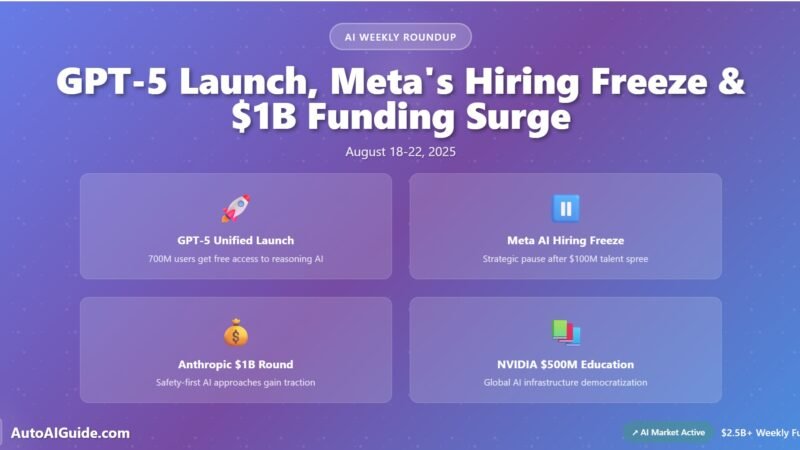
August 18-22, 2025 delivered seismic shifts across the AI ecosystem. OpenAI’s GPT-5 launch unified reasoning and speed in a single model, reaching 700 million weekly users while offering free access to advanced AI reasoning for the first time. Meanwhile, Meta abruptly paused its $100M+ talent acquisition spree amid restructuring concerns, signaling potential market maturation. Anthropic secured a staggering $1 billion Series D funding round, while NVIDIA committed $500 million to democratize AI education globally. The EU’s new AI Safety & Transparency Act set global standards, and early indicators suggest we’re witnessing the transition from AI experimentation to genuine enterprise integration.
📍 Navigate This Week’s Developments
GPT-5: The Unified Intelligence Breakthrough That Changes Everything
OpenAI’s August 7th release of GPT-5 represents more than an incremental model upgrade—it’s a fundamental restructuring of how AI systems balance speed, reasoning, and accessibility. GPT‑5 is a unified system with a smart, efficient model that answers most questions, a deeper reasoning model (GPT‑5 thinking) for harder problems, and a real‑time router that quickly decides which to use.
The significance extends beyond technical capabilities. For the first time, OpenAI made advanced reasoning models freely available to all users, democratizing access to PhD-level AI assistance. This launch will be the first time that Free users have access to a reasoning model, which is a type of model that “thinks,” or carries out an internal chain of thought, before responding.
Technical Innovation: The Router Revolution
GPT-5’s most significant innovation lies in its intelligent routing system. Unlike previous models requiring manual switching between fast and reasoning modes, GPT-5 automatically determines the appropriate response strategy based on query complexity, context, and user intent.
GPT-5 Unified Architecture System
Fast Model
Instant responses for routine queries, factual questions, and simple tasks
Thinking Model
Deep reasoning for complex problems, multi-step analysis, and expert-level tasks
Smart Router
Real-time decision engine that selects optimal response strategy
The router continuously learns from user behavior, preference data, and measured accuracy to improve decision-making over time
This architectural breakthrough has immediate implications for AI integration across industries. Organizations no longer need to manage multiple AI models or train users on when to use different systems—GPT-5 handles optimization automatically while maintaining consistent user experience.
🤖 How will GPT-5’s unified approach change your AI workflow? Whether in development, content creation, or business analysis, what impact do you anticipate from having reasoning and speed automatically optimized? Share your use case predictions below – your insights could help others identify new applications.
Business Impact: The Free Tier Revolution
OpenAI’s decision to provide GPT-5 access to free users represents a strategic market expansion that could reshape competitive dynamics. By removing cost barriers to advanced AI reasoning, OpenAI is positioning itself to capture enterprise customers who begin with free exploration.
Early enterprise feedback suggests significant productivity gains. Cursor says GPT‑5 is “the smartest model [they’ve] used” and “remarkably intelligent, easy to steer, and even has a personality [they] haven’t seen in other models.” Developer-focused companies report GPT-5 achieving state-of-the-art results on recent benchmarks while requiring fewer resources than competitor models.
Meta’s Strategic Retreat: Decoding the AI Hiring Freeze
Meta’s abrupt hiring pause for its AI division, announced August 21st, sent shockwaves through Silicon Valley’s talent market. After months of aggressive recruitment—including multimillion-dollar pay packages to lure top talent away from key rivals—the sudden freeze suggests deeper strategic recalibration.
The numbers tell a compelling story of Meta’s recent AI talent blitz. The company secured more than 20 hires from OpenAI, 13 from Google, three each from Apple and xAI, and two from Anthropic, supplemented by high-profile acquisitions like a $14.3 billion stake in Scale AI.
“For our superintelligence effort, I’m focused on building the most elite and talent-dense team in the industry”
The Talent War Economics
Meta’s hiring spree reveals the extreme economics of AI talent acquisition. Reports suggest compensation packages reaching hundreds of millions of dollars, with Meta offering $2M+/yr in offers for AI talent and still losing them to OpenAI and Anthropic.
AI Talent Retention Rates: Industry Comparison
Source: SignalFire research analysis, industry estimates
Strategic Implications: Market Maturation Signals
Meta’s hiring freeze coincides with broader market signals suggesting AI development may be transitioning from talent acquisition to execution focus. Investor scrutiny has intensified over Meta’s escalating AI expenditures, highlighted by a Morgan Stanley note on August 18 warning that rising stock-based compensation could hinder shareholder returns.
The restructuring divides Meta’s AI efforts into four distinct teams, suggesting a shift from centralized talent accumulation to specialized operational units. This organizational evolution indicates Meta may be moving from the “hire everyone” phase to the “execute systematically” phase of AI development.
Anthropic’s $1B Validation: The Investment Landscape Evolves
Anthropic’s $1 billion Series D funding round, announced on August 20th, 2025, led by existing investors including Amazon and Google, demonstrates continued institutional confidence in AI safety-focused approaches to model development.
The funding round’s significance extends beyond its size. Unlike many AI investments focused purely on capability advancement, Anthropic’s approach emphasizes constitutional AI, interpretability, and safety research—areas increasingly valued by enterprise customers and regulators.
2025 AI Funding Landscape: Major Rounds
Anthropic
Series D – Constitutional AI & Safety
Cohere
Enterprise GenAI Platform
Safe Super-intelligence
Safety-First Model Development
Total: $2.5B+ in major AI funding this week alone
Safety-First Approaches Gain Traction
Anthropic’s funding success reflects growing enterprise and institutional preference for AI systems designed with safety and interpretability as core features rather than afterthoughts. This trend aligns with increasing regulatory scrutiny and corporate governance requirements around AI deployment.
The investment also signals maturation in AI venture funding, shifting from pure capability betting to nuanced evaluation of safety, compliance, and sustainable competitive advantages. For enterprises evaluating AI partnerships, this represents validation of more cautious, safety-oriented approaches to AI integration.
NVIDIA’s Education Gambit: Democratizing AI Infrastructure
NVIDIA’s $500 million global initiative to provide advanced AI infrastructure to universities and research institutions, announced August 21st, represents a strategic investment in long-term AI talent development and market expansion.
The initiative addresses a critical gap in AI education: access to computational resources necessary for advanced research and learning. Universities are often unable to provide students and researchers the computational resources to push the boundaries of current AI education, especially in respect to training deep learning, large language models and generative AI.
📊 NVIDIA Education Initiative Scope
- 100+ institutions: Global reach across universities and research centers
- H100 & H200 GPU clusters: Access to state-of-the-art hardware for on-campus research
- DGX Cloud platform: Scalable cloud infrastructure for distributed learning
- Curriculum integration: Collaborative development of AI courses and certification programs
Strategic Market Implications
NVIDIA’s education investment serves multiple strategic objectives beyond philanthropy. By establishing institutional relationships with universities, NVIDIA positions itself as the default hardware choice for the next generation of AI researchers and professionals.
The initiative also creates a pipeline of NVIDIA-trained talent for enterprise customers, potentially accelerating adoption of NVIDIA-optimized AI architectures across industries. This represents a classic “land and expand” strategy applied to educational infrastructure.
🎓 What role should hardware companies play in AI education? Is NVIDIA’s investment genuinely democratizing access, or creating vendor lock-in for future generations? Share your perspective on corporate-sponsored education – especially if you’re in academia or workforce development.
EU AI Safety & Transparency Act: Setting Global Standards
The European Parliament’s passage of the AI Safety & Transparency Act on August 20, 2025 establishes the world’s most comprehensive framework for AI governance, with implications extending far beyond European borders.
The legislation introduces strict requirements for high-risk AI systems, including mandatory disclosure of training data sources for high-impact AI models and risk classification tiers requiring enhanced testing and certification.
EU AI Act: Global Compliance Requirements
❌ Prohibited AI Systems
- Social scoring systems
- Real-time biometric surveillance in public
- Subliminal manipulation techniques
⚠️ High-Risk Applications
- Healthcare diagnostics
- Employment screening
- Financial services
✅ Compliance Requirements
- Mandatory auditing and testing
- Training data transparency
- Human oversight mechanisms
Maximum Penalties: €30 million or 6% of global annual revenue, whichever is greater
Global Compliance Ripple Effects
The EU’s regulatory approach is already influencing policy discussions globally, creating a “Brussels Effect” for AI governance. Companies operating internationally will likely adopt EU-compliant practices universally rather than maintaining separate compliance frameworks.
This regulatory framework particularly impacts the developments covered earlier in this roundup. GPT-5’s transparency and safety features position OpenAI well for EU compliance, while Meta’s AI restructuring may partially reflect preparation for regulatory requirements. Anthropic’s constitutional AI approach appears specifically designed for this regulatory environment.
Market Implications: The Maturing AI Ecosystem
This week’s developments collectively signal the AI industry’s transition from experimental chaos to systematic maturation. Several converging trends support this analysis:
From Talent Hoarding to Strategic Execution
Meta’s hiring pause, combined with Anthropic’s high retention rates, suggests the market is shifting from raw talent acquisition to effective team utilization. Companies are recognizing that simply hiring AI researchers doesn’t guarantee breakthrough outcomes—organizational structure and strategic focus matter more.
Enterprise Integration Acceleration
GPT-5’s enterprise adoption metrics and Anthropic’s constitutional AI approach indicate genuine business integration rather than experimental pilots. 5 million paid users now use ChatGPT business products, suggesting AI has moved beyond proof-of-concept to operational necessity for many organizations.
This trend is reinforced by the regulatory framework emerging from the EU, which assumes AI systems will be deployed at scale across critical infrastructure and decision-making processes. Regulations don’t typically precede experimental technology—they follow established, impactful systems.
Infrastructure Investment vs. Application Development
NVIDIA’s education initiative reflects a broader shift toward infrastructure investment rather than pure model development. As foundation models reach performance parity in many tasks, competitive advantage increasingly comes from implementation, integration, and specialized applications.
🔄 Ready for the Next AI Evolution Phase?
The AI industry is clearly transitioning from the experimental phase to systematic implementation. Companies that understand this shift—from talent hoarding to strategic execution, from general models to specialized applications—will capture disproportionate value in the next wave. Explore how agentic AI systems and autonomous marketing platforms are driving this transformation.
Forward Outlook: September 2025 and Beyond
Based on this week’s developments, several key trends will likely dominate the coming months:
Consolidation in AI Model Development: With GPT-5 setting new performance benchmarks and regulatory frameworks solidifying, expect smaller model developers to either specialize in niche applications or seek acquisition by larger players.
Enterprise AI Governance: The EU’s regulatory framework will drive increased investment in AI governance tools, audit systems, and compliance software. Companies building in this space may see significant opportunity.
Education and Workforce Development: NVIDIA’s education initiative reflects broader recognition that AI adoption is constrained by talent availability rather than technology capability. Expect increased investment in AI literacy programs across sectors.
Safety and Constitutional AI: Anthropic’s funding success suggests investors are valuing safety-first approaches. Expect more startups positioning around responsible AI development and deployment.
The AI industry is clearly entering a new phase characterized by systematic execution, regulatory compliance, and genuine business integration. Companies that recognize and adapt to this shift will be best positioned for sustainable success in the evolving AI landscape.
🔮 What’s your prediction for the next major AI development? Will we see more consolidation, breakthrough applications, or regulatory interventions dominating headlines? Share your forecasts and reasoning – let’s build a community-driven outlook for AI’s next chapter.
✅ Sources
- OpenAI: Introducing GPT-5
- CNBC: OpenAI launches new GPT-5 model for all ChatGPT users
- CNBC: Meta puts the brakes on its massive AI talent spending spree
- Boston Institute of Analytics: AI & Data Science Weekly Roundup August 18-22
- TechCrunch: OpenAI’s GPT-5 is here
- Tom’s Hardware: Despite $2M salaries, Meta can’t keep AI staff
- CNBC: AI is creating new billionaires at a record pace
- Gartner: Hype Cycle Identifies Top AI Innovations in 2025
- Crescendo AI: Latest AI Breakthroughs and News August 2025
- The Gateway Pundit: Meta Pauses AI Hiring Spree Amid Restructuring
💬 What’s your take on this week’s biggest AI developments?
From GPT-5’s unified architecture to Meta’s strategic hiring pause, from billion-dollar funding rounds to new regulatory frameworks – this week reshaped the AI landscape. Which development do you think will have the biggest long-term impact? What trends are you watching most closely?
Join the discussion below and help us analyze where AI is headed next. Your insights and predictions could identify the next big breakthrough before it hits the headlines.